jianguli@goodlyglue.com
+86-18948072250

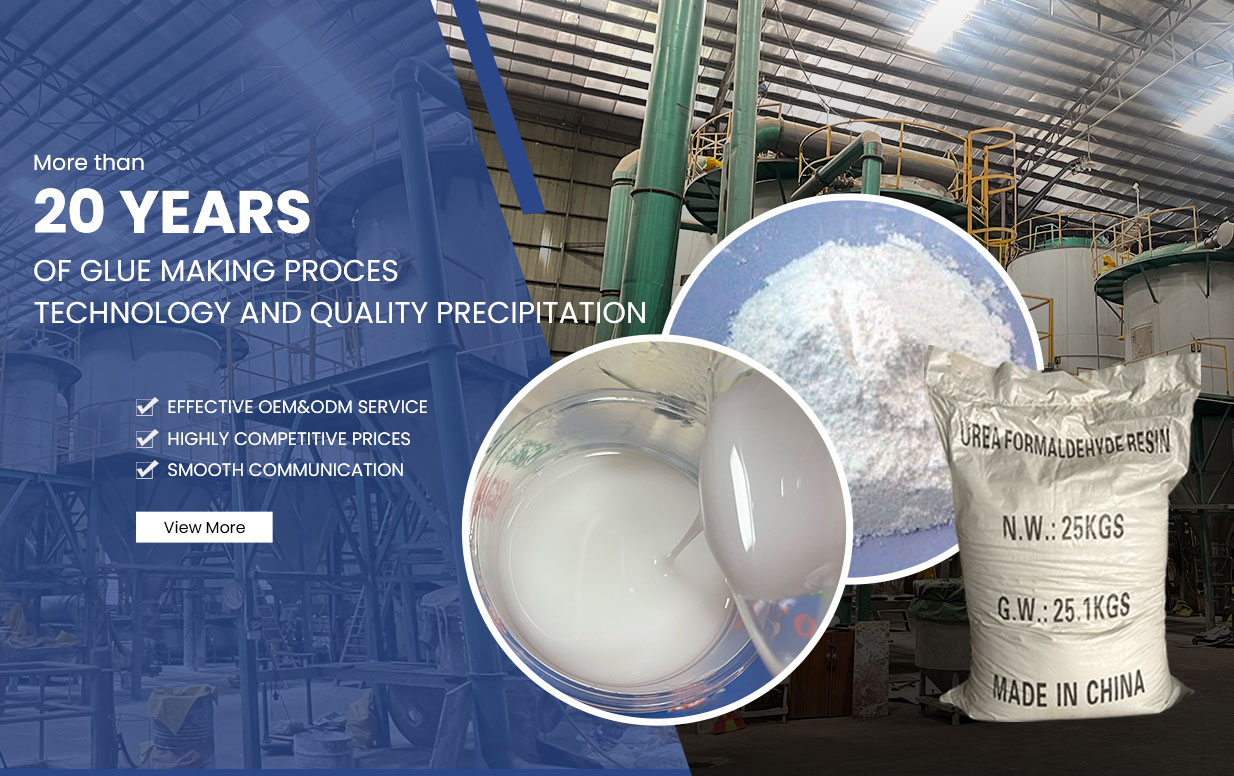
Selecting the right adhesive system is not just a chemistry decision. It shapes panel durability, press efficiency, surface quality, compliance strategy, and final product positioning. In the industrial resin manufacturing industry, UF and MUF remain two of the most important thermosetting resin systems for wood panels, plywood, veneered boards, and decorative materials. GOODLY focuses on these resin families and supplies powder solutions for wood processing and lamination, backed by more than 20 years of adhesive production experience and a product range that covers both UF and MUF applications.
UF resin means urea formaldehyde resin. It is widely used because it cures fast, bonds well, processes efficiently, and stays cost competitive in high-volume board production. GOODLY’s portfolio shows uf resin powder applied in plywood, particleboard, MDF, HDF, bent wood, and veneer bonding, which reflects where this chemistry performs best in large-scale factory settings.
MUF resin means melamine urea formaldehyde resin. In simple terms, it is a melamine modified resin built by introducing melamine into the UF system. That melamine addition changes the performance balance. Research and industry technical references consistently show that MUF offers stronger resistance to moisture and heat than standard UF, while also helping improve durability in more demanding service conditions. GOODLY positions MUF products for wood processing and decorative paper impregnation, which matches these higher-performance requirements.
The biggest difference is performance under demanding conditions.
UF resin is usually preferred when the target is fast curing, efficient pressing, strong dry bond strength, and controlled cost. It is a practical choice for many interior-grade products where production speed and adhesive economy matter most. MUF resin adds melamine, so the cured network becomes more resistant to water, heat, and long-term environmental stress. That makes MUF more suitable when the board or laminated product faces higher humidity, more severe processing conditions, or stricter durability expectations.
This is the clearest way to read the UF vs MUF resin decision:
| Property | UF Resin | MUF Resin |
|---|---|---|
| Main composition | Urea and formaldehyde | Urea, melamine, and formaldehyde |
| Cost position | Lower | Higher than UF |
| Cure speed | Fast | Good, but formulation dependent |
| Dry bond strength | Strong | Strong |
| Moisture resistance | Moderate | Better |
| Heat resistance | Moderate | Better |
| Decorative paper use | Suitable in many standard uses | Better for higher-demand lamination |
| Typical focus | Interior boards and efficient mass production | Higher-performance boards and laminates |
The table reflects the general UF vs MUF performance comparison seen in technical literature and commercial adhesive selection.
UF has never stayed important by accident. It remains a core resin in panel production because it supports stable throughput. In wood adhesives, scale matters. Grand View Research estimated the global wood adhesives market at USD 7.03 billion in 2023 and projected an 8.6 percent compound annual growth rate from 2024 to 2030, with plywood, particleboard, and other engineered wood panels as major demand drivers. In that environment, a resin that cures quickly and fits mainstream pressing lines keeps strong commercial value.
For many factories, UF supports a highly efficient cost-to-output structure. It works well in plywood, MDF, HDF, particleboard, veneer sticking, and bent wood production, all categories that GOODLY already serves with targeted powder resin products. That product alignment matters because resin selection is rarely universal. It works best when the supplier understands the actual board type, fiber structure, pressing window, and required bond profile.
MUF becomes attractive when the product must hold performance beyond standard interior conditions. A USDA Forest Service study on melamine-modified UF systems found that MUF formulations improved formaldehyde emission performance and internal bond strength in particleboard development, showing why melamine addition is used as an upgrade path rather than a simple material substitution.
That is why MUF is commonly considered for decorative paper impregnation, moisture-sensitive panels, and applications where a better balance of durability and appearance is needed. GOODLY’s product line specifically includes impregnated paper melamine urea formaldehyde resin, which fits this technical direction well.
The UF or MUF decision is not only about bond strength. It is also tied to compliance planning. The U.S. EPA states that hardwood plywood, medium-density fiberboard, and particleboard sold or imported in the United States must meet TSCA Title VI requirements, including certification, labeling, and testing oversight. That makes adhesive formulation control and emission management part of the purchasing discussion, not an afterthought.
In practice, this means manufacturers need a resin partner that can support consistent production rather than only supply material. A stable formulation, reliable powder quality, controlled free formaldehyde, and application-specific matching all matter when product qualification must hold across repeated runs. GOODLY highlights customized resin development, technical upgrades, and quality-focused production, which directly supports this part of the selection process.
Choose UF resin when the goal is high production efficiency, strong dry bonding, interior-grade application, and cost control. This is especially relevant in mainstream plywood lines, density board production, particleboard, and veneer bonding where the process window is already mature and output consistency is the priority.
Choose MUF resin when the product must handle more humidity, better heat resistance, upgraded decorative surface requirements, or tighter performance targets. It is also a logical step when the buyer wants to move the product line upward in durability without moving to a completely different resin family.
GOODLY is not presenting UF and MUF as abstract catalog terms. Its site shows practical alignment with real applications, including plywood uf resin powder, particleboard uf resin powder, Density Board UF Resin Powder, bent wood UF resin powder, veneer glue powder, and MUF resin for impregnated paper. Combined with its founding background, more than 20 years of adhesive experience, and emphasis on customized products, this gives buyers a clearer path from resin type to production result.
The short answer is this: UF resin is the efficient choice for fast-curing, cost-sensitive, high-volume interior wood manufacturing, while MUF resin is the upgraded option when moisture resistance, heat resistance, durability, and more demanding application performance matter more. A well-judged resin choice improves not only board quality, but also processing stability, compliance readiness, and long-term product consistency. For companies comparing resin systems seriously, the real question is not which one is better in general, but which one fits the target board, the press line, the compliance market, and the product promise more accurately.