jianguli@goodlyglue.com
+86-18948072250

Mass production places continuous stress on every variable in the bonding process. Small fluctuations that are manageable in trial runs can quickly expand into large-scale defects when output increases. In wood panel manufacturing, adhesive consistency becomes the foundation of product quality, directly influencing bonding strength, surface finish, and rejection rates. Achieving reliable adhesive stability control is therefore not just a technical task, but a core requirement for scalable production.
According to data from FAO, global wood-based panel output has exceeded 380 million cubic meters annually, reflecting the rapid expansion of manufacturing capacity. As production volumes grow, maintaining uniform adhesive behavior across batches becomes increasingly challenging, especially under varying raw material and environmental conditions.
In continuous manufacturing, adhesives must perform the same way across thousands of panels per day. Any inconsistency in viscosity, curing speed, or bonding strength can lead to uneven quality, increased waste, and production downtime.
Stable adhesive systems support:
Uniform glue spread and penetration
Predictable curing during hot pressing
Reduced variation between production batches
Lower defect rates and rework
The USDA Wood Handbook highlights that adhesive bonding performance depends on consistent interaction between resin and wood surfaces. When adhesive properties fluctuate, bondline quality becomes unstable, increasing the risk of delamination and structural weakness.
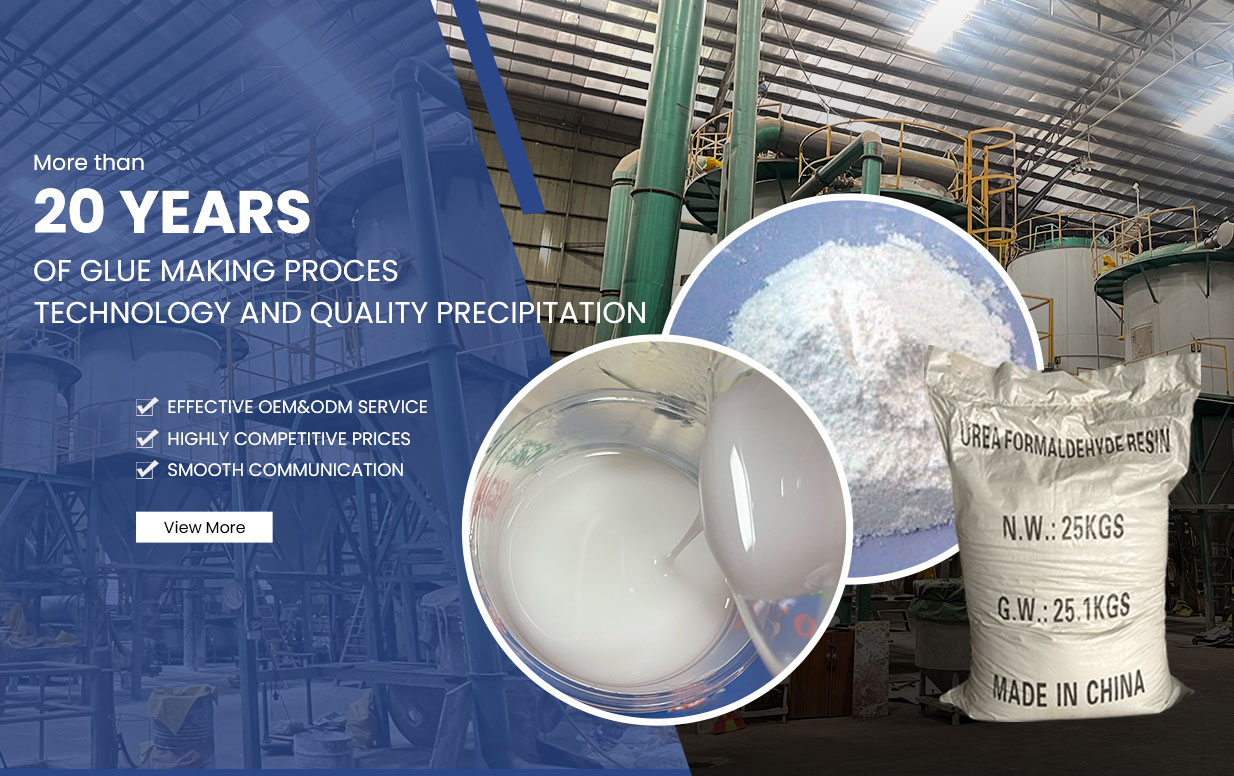
Adhesive stability begins with raw materials. Variations in resin composition, filler quality, or additives can lead to unpredictable performance. Using standardized materials, such as high-quality uf resin adhesive powder, helps ensure that each batch starts from the same baseline.
Powder-based systems also reduce the risk of degradation during storage compared to liquid adhesives, supporting long-term stability in production environments.
Mixing is a critical stage where many inconsistencies are introduced. Incorrect ratios, uneven mixing, or variations in mixing time can result in unstable viscosity and curing behavior.
Establishing fixed mixing parameters, including water ratio, temperature, and mixing duration, ensures repeatable adhesive preparation and contributes to consistent glue performance.
Temperature and humidity directly influence adhesive properties. High temperatures can reduce viscosity, while excessive humidity may affect curing and bonding strength.
Maintaining controlled workshop conditions minimizes these external influences and supports stable adhesive behavior throughout the production cycle.
Stable production relies on clearly defined process parameters. Glue spread rate, assembly time, pressing temperature, and pressure must all be standardized and monitored.
APA manufacturing guidelines emphasize that bonding performance depends on consistent control of these variables. Without standardization, even high-quality adhesives cannot deliver stable results.
Application equipment such as glue spreaders and mixers must operate consistently. Wear and calibration errors can cause uneven glue distribution or incorrect dosing, leading to variability in bonding quality.
Regular maintenance and calibration help ensure that equipment performance matches process requirements.
| Control Area | Key Practice | Impact on Stability |
|---|---|---|
| Material selection | Use standardized adhesive formulations | Reduces batch variation |
| Mixing control | Fix ratios and mixing procedures | Ensures uniform viscosity |
| Environment control | Maintain stable temperature and humidity | Prevents property fluctuation |
| Process monitoring | Track glue spread and press parameters | Improves consistency |
| Equipment management | Regular calibration and inspection | Maintains accurate application |
These strategies form the backbone of stable wood adhesive production, especially in high-output manufacturing lines.
Adhesive formulation determines how sensitive the system is to process variations. A well-designed resin system can tolerate minor fluctuations without compromising bonding performance.
GOODLY focuses on developing adhesive formulations that balance curing speed, viscosity stability, and bonding strength. Its powder-based systems are engineered to provide predictable performance under different production conditions, reducing the need for frequent adjustments.
In the industrial glue supply industry, suppliers that can deliver consistent formulation quality play a key role in supporting large-scale manufacturing operations.
In mass production, instability often appears as:
Fluctuating viscosity between batches
Uneven glue spread across panels
Variations in curing performance
Increased defect rates
Addressing these issues requires a combination of material control, process discipline, and supplier reliability. Using stable adhesive systems, combined with strict process management, helps minimize these risks.
With over two decades of experience in resin development, GOODLY provides adhesive solutions designed for high-volume manufacturing. Its products are developed with a focus on consistency, allowing production lines to maintain stable performance even under demanding conditions.
By offering customized formulations and reliable powder systems, GOODLY supports manufacturers in achieving uniform bonding quality while improving operational efficiency.
Ensuring adhesive stability in mass production requires more than selecting a high-quality product. It involves controlling every stage of the process, from raw materials to final pressing conditions.
A stable adhesive system, combined with standardized production practices, enables manufacturers to achieve consistent quality, reduce waste, and maintain efficient operations at scale. In high-volume environments, stability is not an advantage but a necessity for long-term success.