jianguli@goodlyglue.com
+86-18948072250

Selecting the right adhesive is one of the most decisive factors in laminated board performance. Strength, durability, and resistance to environmental changes all depend on how well the adhesive forms and maintains the bondline between layers. In large-scale production, the choice of a suitable laminated board adhesive glue is not only about bonding strength, but also about processing stability, efficiency, and cost control.
Data from the Food and Agriculture Organization shows that global wood-based panel production continues to grow steadily, with plywood, particleboard, and fiberboard forming the core of structural and decorative materials. As demand increases, adhesive systems must deliver consistent quality under high-speed manufacturing conditions, making glue selection a critical decision in the wood lamination industry.
There is no single universal adhesive that fits every laminated board application. The best option depends on board type, usage environment, and production process. However, high-performing adhesives share several key characteristics:
Strong internal bonding strength
Controlled viscosity for even spread
Stable curing performance during hot pressing
Resistance to moisture and temperature changes
Compatibility with automated production lines
According to the USDA Wood Handbook, adhesive bonding performance relies heavily on the interaction between resin chemistry and wood surface condition. Proper wetting, penetration, and curing are required to achieve durable bonding.
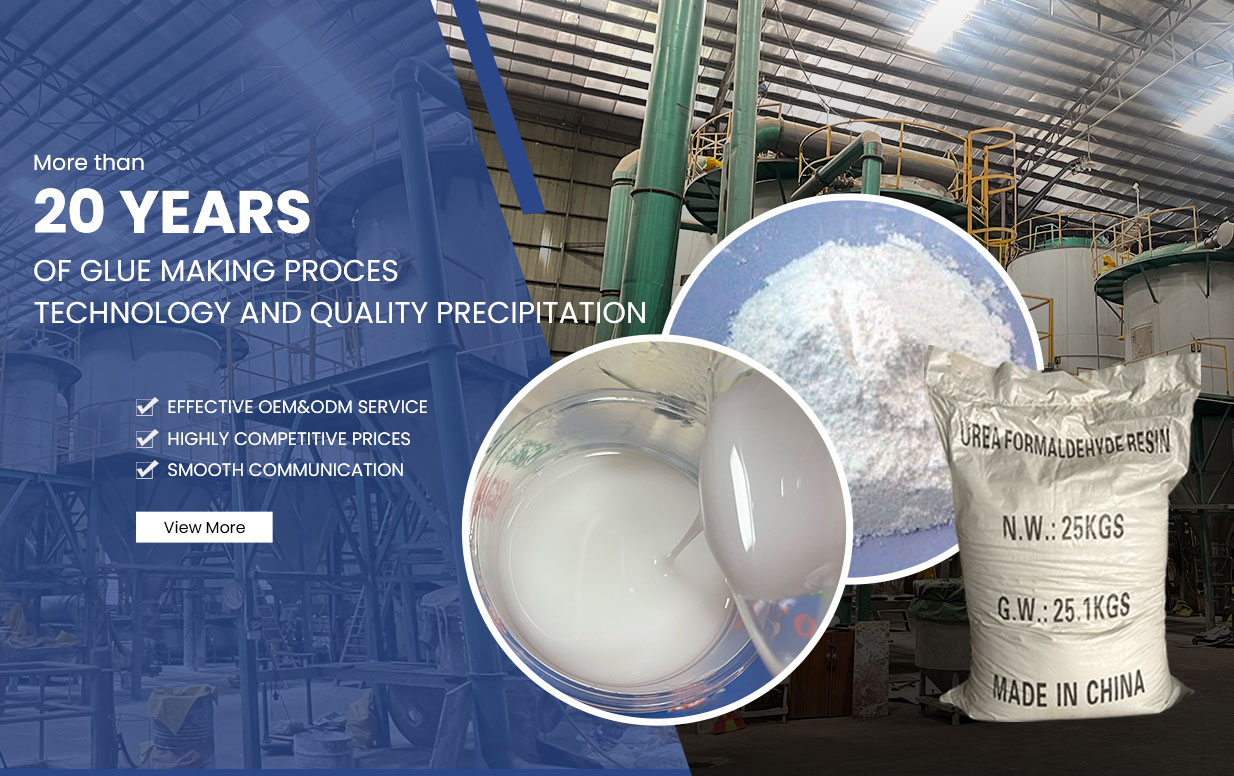
Urea formaldehyde remains one of the most widely used systems due to its cost efficiency and fast curing speed. It is commonly used for interior panels and furniture boards. As a standard wood lamination resin, it provides a balanced combination of bonding strength and processing efficiency.
Modern formulations, especially in powder form, offer improved storage stability and easier handling compared to liquid resins.
MUF systems enhance water resistance and durability compared to standard UF adhesives. They are suitable for applications requiring higher performance, such as humid environments or semi-exterior use.
PF adhesives provide excellent weather resistance and structural strength. They are typically used in exterior-grade plywood and structural laminated boards, although they require higher curing temperatures and longer press cycles.
In recent years, artificial board glue powder has become increasingly popular in manufacturing due to its flexibility and consistency. Powder adhesives allow manufacturers to control mixing ratios, viscosity, and curing speed more precisely.
GOODLY’s resin powder solutions are designed to provide stable bonding performance while simplifying storage and transportation. Compared with liquid adhesives, powder systems reduce the risk of degradation during storage and support more predictable production results.
Interior furniture panels, decorative boards, and structural plywood all have different performance expectations. For interior use, UF systems are often sufficient. For higher moisture exposure, MUF or PF systems are more suitable.
Fast curing adhesives improve throughput and reduce energy consumption. GOODLY formulations are optimized for hot pressing efficiency, helping manufacturers maintain stable cycle times.
Adhesive emissions and safety standards are increasingly important in global markets. Modern resin systems are engineered to meet strict emission requirements while maintaining bonding strength.
The best adhesive is not necessarily the most expensive one. It is the one that delivers consistent quality with minimal waste and rework under actual production conditions.
| Adhesive Type | Strength | Water Resistance | Cost Level | Typical Use |
|---|---|---|---|---|
| Urea formaldehyde | Good | Moderate | Low | Interior panels |
| Melamine UF | Higher | Good | Medium | Moisture-resistant boards |
| Phenol formaldehyde | Very high | Excellent | High | Exterior structural panels |
This comparison highlights that adhesive selection should align with both product requirements and manufacturing capability.
GOODLY focuses on developing high-performance resin systems tailored for wood panel manufacturing. With more than 20 years of experience, the company provides customized adhesive solutions that balance strength, curing speed, and process stability.
Its powder-based adhesive systems are designed for consistent mixing, reliable bonding, and efficient large-scale production. These characteristics are especially important when selecting a glue for laminated wood boards, where uniformity across batches directly impacts product quality.
By offering flexible formulation options, GOODLY supports manufacturers in adapting to different raw materials, climates, and production setups without compromising performance.
Choosing the best adhesive for laminated boards requires a clear understanding of application needs, production conditions, and long-term performance expectations. Adhesives are not just materials but integral parts of the manufacturing system.
A well-matched wood lamination resin, combined with controlled processing, ensures strong bonding, stable quality, and efficient production. Manufacturers that prioritize adhesive selection as a strategic factor can achieve better consistency, lower defect rates, and stronger competitiveness in the market.