jianguli@goodlyglue.com
+86-18948072250

Stable viscosity is one of the most critical parameters in wood adhesive production because it directly determines glue spread, penetration depth, and final bond strength. In modern panel plants, even small fluctuations in viscosity can lead to uneven coating, poor bonding interfaces, or excessive consumption of adhesive. As production capacity increases across the industrial adhesive manufacturing industry, maintaining consistent viscosity has become essential for both quality assurance and cost control.
According to the USDA Wood Handbook, adhesive flow behavior influences bondline formation and wood penetration, which are key factors affecting mechanical strength and durability. When viscosity is too low, overpenetration may occur, weakening the bondline. When viscosity is too high, poor wetting and insufficient spreading can result in incomplete bonding.
Viscosity defines how an adhesive behaves during application and pressing. It affects transfer efficiency from roller to veneer, distribution uniformity, and the interaction between resin and wood fibers. In plywood and laminated panel production, improper viscosity often leads to inconsistent glue lines and unstable product performance.
A balanced viscosity ensures:
Uniform glue spread across veneer surfaces
Controlled penetration into wood structure
Stable bonding interface formation
Efficient use of adhesive materials
For UF systems, achieving proper adhesive viscosity control is particularly important because curing speed and water content are closely linked to viscosity behavior during processing.
The primary determinant of viscosity is the resin formulation. Higher solids content generally increases viscosity, while lower solids reduce it. In uf resin systems, the molar ratio of urea to formaldehyde and the degree of polymerization directly influence flow characteristics.
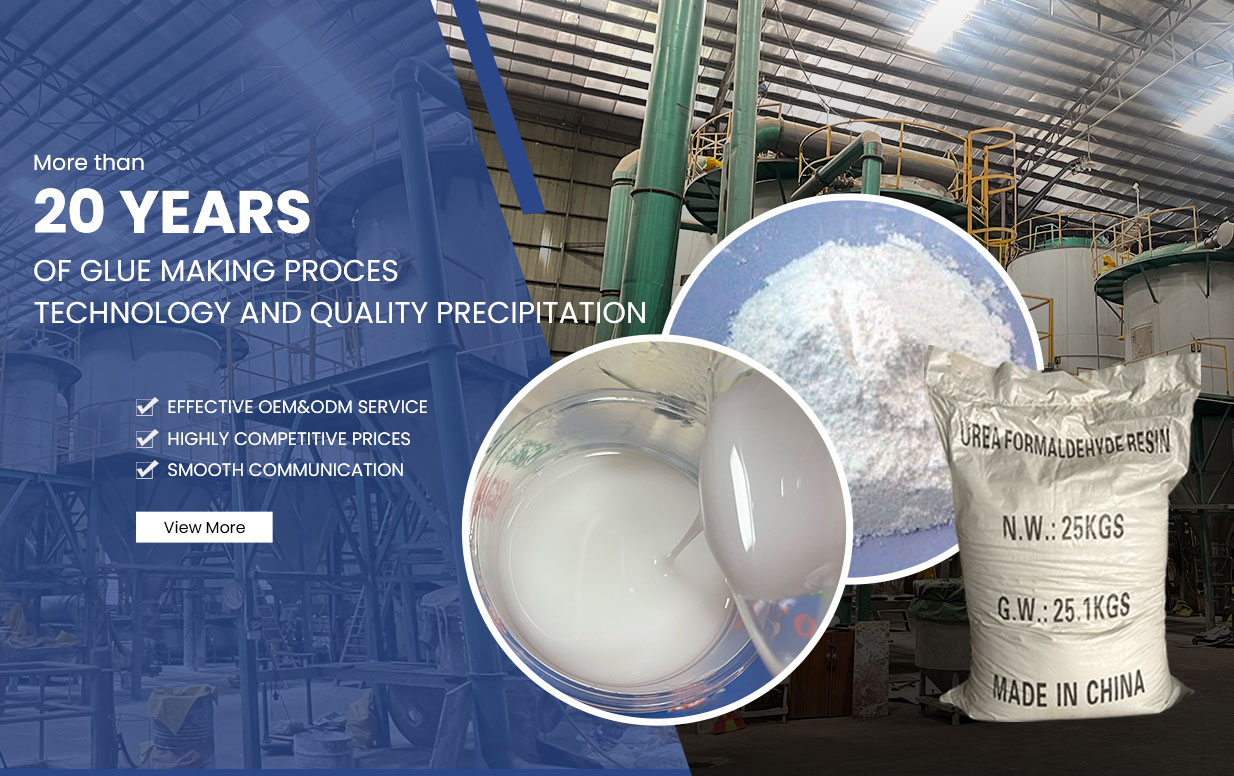
GOODLY provides solutions such as Bend Wood UF Resin Powder, which offers stable formulation control and predictable viscosity behavior after mixing. This allows manufacturers to maintain consistent processing conditions even under varying environmental factors.
Temperature has a direct impact on viscosity. As temperature increases, viscosity decreases due to reduced intermolecular resistance. In production environments, uncontrolled temperature fluctuations can cause significant changes in adhesive performance.
Maintaining a stable mixing and storage temperature helps avoid unexpected viscosity shifts, especially in large-scale continuous operations.
Water is commonly used to adjust viscosity in UF adhesive systems. However, excessive dilution reduces bonding strength and curing efficiency. Insufficient dilution may result in overly thick adhesive that cannot spread evenly.
Precise control of water ratio is essential when performing resin viscosity adjustment, ensuring that the adhesive maintains both workability and bonding performance.
Fillers such as wheat flour or mineral powders are often used to modify viscosity and improve gap-filling properties. Thickening agents can increase viscosity stability, while certain modifiers enhance flow characteristics.
The correct combination of additives allows manufacturers to fine-tune adhesive performance without compromising structural integrity.
Improper mixing can lead to uneven viscosity distribution. Insufficient mixing results in localized thick or thin areas, while overmixing may affect resin stability.
A controlled mixing process ensures uniform dispersion of components and consistent viscosity throughout the batch.
To effectively control UF resin viscosity, manufacturers typically follow a structured approach:
| Control Method | Key Action | Result |
|---|---|---|
| Raw material consistency | Use stable resin powder formulation | Reduces batch variation |
| Water ratio control | Measure dilution precisely | Maintains balance between flow and strength |
| Temperature management | Keep mixing environment stable | Prevents viscosity fluctuation |
| Additive optimization | Adjust fillers and modifiers carefully | Improves application performance |
| Mixing standardization | Use fixed mixing time and speed | Ensures uniform viscosity |
These methods help create a repeatable production process, which is critical for large-scale panel manufacturing.
In daily production, viscosity issues often appear in the following forms:
Adhesive too thin: leads to overpenetration and weak bonding
Adhesive too thick: causes poor spreading and surface defects
Viscosity instability: results in inconsistent product quality
Solutions include adjusting water ratio, optimizing formulation, and improving process control. Using a stable product like GOODLY’s uf resin powder reduces the need for frequent corrections and minimizes production risks.
From a manufacturing perspective, consistency is more valuable than occasional performance peaks. GOODLY focuses on providing adhesive systems with predictable viscosity behavior, ensuring that production lines operate smoothly without frequent parameter adjustments.
With over two decades of experience in resin development, GOODLY supports customized formulation based on specific production requirements. Its adhesive powders are designed for easy mixing, controlled flow, and reliable bonding performance across different wood panel applications.
This approach helps manufacturers maintain steady output, reduce waste, and improve overall process efficiency.
Viscosity control is not a single adjustment step but a coordinated process involving formulation, environment, and production discipline. A stable adhesive system, combined with precise process control, ensures consistent bonding quality and efficient manufacturing.
In wood adhesive production, controlling viscosity means controlling the entire bonding outcome. Manufacturers that prioritize this parameter are better positioned to achieve stable product performance, reduced defects, and long-term production reliability.