jianguli@goodlyglue.com
+86-18948072250

Reliable panel bonding starts with the chemistry behind the powder. For woodworking factories, furniture component plants, plywood producers, and laminated board workshops, glue powder is not only a bonding material. It affects hot press speed, board strength, storage stability, emission control, production loss, and final product consistency.
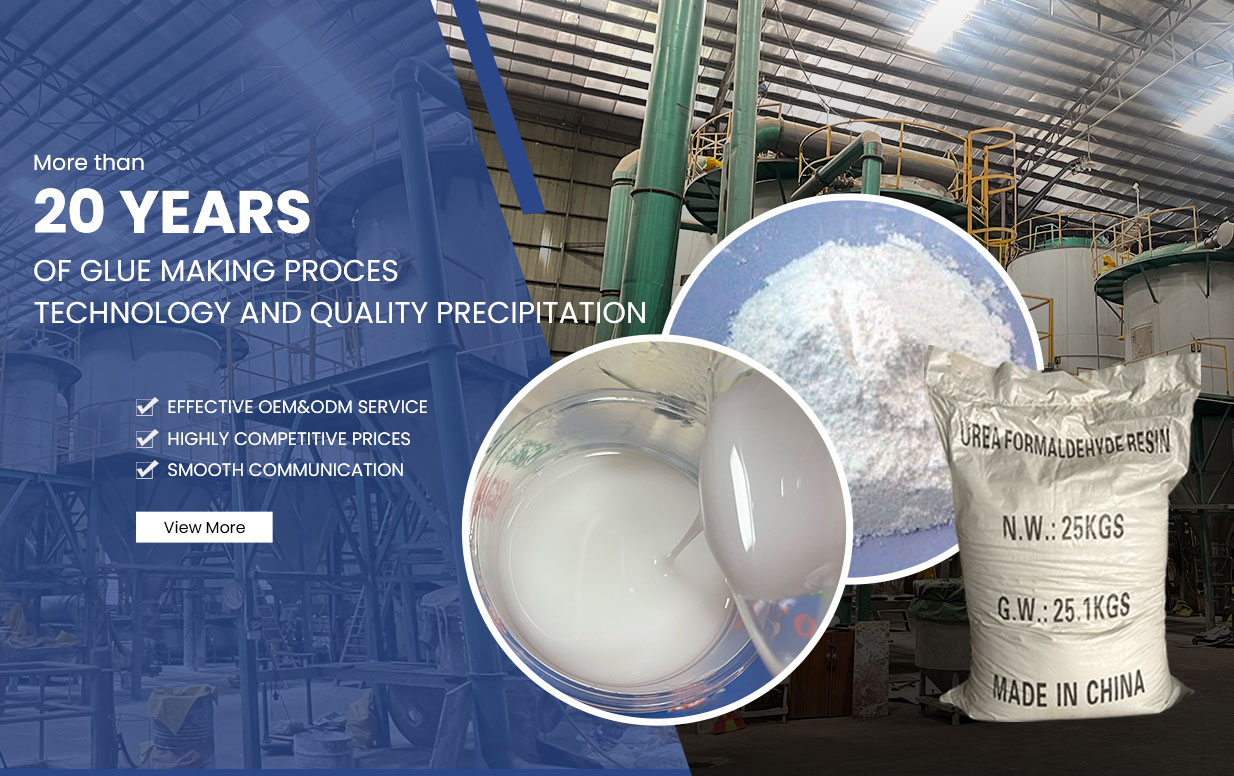
GOODLY focuses on Urea Formaldehyde Resin Powder for industrial woodworking applications. The material is supplied in dry powder form, then mixed with water before use. This format helps factories reduce transport weight, improve storage convenience, and prepare adhesive according to their own production rhythm. GOODLY’s UF resin powder is designed for plywood, particleboard, bent wood, furniture parts, and other wood-based manufacturing needs.
The core of industrial glue powder is usually a thermosetting resin system. For wood bonding, urea formaldehyde resin powder is widely used because it cures under heat and pressure, forming a hard bonding network between wood fibers, veneers, or particles.
The basic industrial glue powder composition includes urea, formaldehyde-based resin, curing agents, fillers, flow-control additives, and sometimes performance modifiers. ScienceDirect notes that UF adhesive production commonly involves urea addition in multiple reaction stages, pH adjustment, condensation reaction, neutralization, and water removal to reach the required resin concentration.
For buyers, this means glue powder quality is not decided by one single ingredient. It depends on formulation balance, reaction control, drying stability, powder fineness, solubility, curing behavior, and batch consistency.
| Component | Function in Wood Glue Powder | Why It Matters in Production |
|---|---|---|
| Urea formaldehyde resin | Main bonding structure | Provides cured strength after hot pressing |
| Curing agent | Controls reaction speed | Affects press time and working time |
| Filler or extender | Adjusts viscosity and spreadability | Helps glue apply evenly on veneer or particles |
| Flow additive | Improves powder handling | Reduces caking and uneven mixing |
| Moisture control system | Supports storage stability | Helps maintain performance during transport |
These wood adhesive materials must work together. Too much curing speed may shorten usable time after mixing. Too slow curing may reduce press efficiency. Poor powder dispersion may create weak bonding points, surface defects, or delamination after pressing.
Powder resin and liquid resin share similar chemistry, but their production and handling logic are different. Liquid UF resin is normally used quickly because water content and storage time affect stability. Powder resin can be transported and stored more conveniently, then re-dispersed in water before application.
A study published in the International Journal of Scientific and Research Publications reported that liquid UF resin used in wood panel production may have limited storage life, while UF powder can be re-dissolved or re-dispersed in water at the required concentration before use. The same research also discussed efforts to improve gel time, adhesive bond strength, storage life, and handling convenience.
For factories with changing production schedules, this powder format is useful. It can support seasonal orders, mixed product specifications, trial production, and bulk order planning without depending completely on short-life liquid adhesive inventory.
The composition of UF resin powder starts from a resin formed by urea and formaldehyde through controlled reaction. After the resin reaches the required molecular structure, it is processed into powder form. The powder must dissolve or disperse evenly in water and maintain stable bonding performance during production.
GOODLY’s wood uf resin powder is positioned for woodworking and panel applications, including plywood, particleboard, and bent wood components. The product information emphasizes adhesive strength, ease of mixing, stable application, and support for preventing cracking or delamination in wood processing.
A good UF resin powder should normally show:
Clean and uniform powder appearance
Good water mixability
Stable viscosity after preparation
Suitable curing speed under hot pressing
Strong dry bonding strength
Controlled emission performance
Low caking risk during storage
Many suppliers can describe the same basic ingredients, but industrial performance depends on process control. Urea-to-formaldehyde ratio, reaction temperature, pH curve, condensation degree, drying method, and particle size all influence the final adhesive.
For plywood production, the glue must penetrate veneer surfaces but should not over-penetrate into the wood. For particleboard, the adhesive needs enough distribution uniformity to coat particles efficiently. For bent wood, the bond must resist stress during forming and later use.
GOODLY supports this by focusing on application-oriented resin powder rather than only selling a generic chemical. Different woodworking processes need different viscosity, curing time, and bonding strength targets. This is where stable formulation control becomes important for industrial buyers.
Before purchasing glue powder, factories should not only ask what the powder is made of. They should also ask how the formula behaves in real production.
| Test Item | Practical Meaning | Procurement Concern |
|---|---|---|
| Gel time | Shows curing speed | Helps match hot press cycle |
| Viscosity after mixing | Shows spreadability | Affects coating uniformity |
| Moisture content | Shows powder stability | Reduces caking and storage risk |
| Bonding strength | Shows final board reliability | Reduces delamination complaints |
| Free formaldehyde control | Shows emission management | Supports safer product standards |
| Powder solubility | Shows mixing convenience | Reduces glue lumps and waste |
Research on UF resin adhesives commonly reports that pH, solid content, viscosity, catalyst level, and gel time are important indicators for curing behavior and bonding performance. One Wood Research paper recorded UF adhesive testing data including solid content, density, pH value, viscosity, catalyst addition, and gel time evaluation.
The industrial chemical materials industry is moving toward more stable, measurable, and application-specific materials. Wood panel manufacturers no longer only compare price per kilogram. They also consider storage cost, defect rate, press efficiency, emission requirements, and after-sales technical support.
UF resin powder remains widely used in wood-based composite panel manufacturing because it offers fast curing, good panel performance, water solubility, and cost efficiency. Academic research also points out that UF resin has limitations in high-moisture or water-exposed conditions, so choosing the right application and formula is important.
This is why GOODLY’s product positioning matters. For indoor furniture boards, plywood, bent wood parts, and general woodworking production, UF resin powder can offer a balanced solution when the formulation is matched correctly with process conditions.
GOODLY provides UF resin powder solutions for wood processing factories that need steady bonding performance and practical production control. The value is not only the powder itself, but also the ability to support different usage scenarios.
GOODLY’s advantages include:
Focused production of urea formaldehyde resin powder
Products designed for plywood, particleboard, bent wood, and woodworking use
Powder format that supports storage and transport convenience
Formulation attention for bonding strength and mixing performance
Practical suitability for wholesale supply and repeated industrial purchasing
For procurement teams, a stable supplier helps reduce hidden costs. Poor glue powder may cause uneven curing, veneer separation, edge cracking, panel rejection, or delayed delivery. A consistent resin powder helps production teams keep press parameters stable and reduce rework.
Industrial wood glue powder is made from a controlled resin system, not just simple chemical blending. Its main structure comes from UF resin chemistry, while curing agents, fillers, flow-control additives, and process adjustments help the powder perform in real woodworking production.
GOODLY’s UF resin powder is developed for factories that need reliable bonding, convenient handling, and stable results across wood-based applications. When buyers evaluate adhesive powder, the right question is not only what it is made of, but whether its composition can support continuous production, consistent quality, and lower manufacturing risk.