jianguli@goodlyglue.com
+86-18948072250

Choosing uf resin powder for particleboard is not only about buying glue at the lowest price. In high-volume production, the better question is whether the resin can keep bond strength stable, cure fast enough for the press line, and stay within the emission target required by the destination market. A resin that looks cheaper on paper can become expensive once it causes board breakage, slower press cycles, rework, or compliance risk. For particleboard exported to the United States, EPA TSCA Title VI sets the formaldehyde emission limit for particleboard at 0.09 ppm, so resin selection directly affects both product performance and market access.
UF resin remains one of the most widely used adhesive systems for interior-grade particleboard because it cures relatively fast, supports efficient panel production, and usually offers a lower adhesive cost than more moisture-resistant resin systems. At the same time, formaldehyde release and cure behavior must be carefully controlled. Research and industry references consistently show that resin chemistry, excess formaldehyde, press temperature, press cycle time, and catalyst dosage all influence final board quality and emissions.
A good UF resin powder should help the board maintain internal integrity after pressing, trimming, sanding, and downstream handling. In real factory conditions, this means consistent bonding between wood particles across the face and core layers, not just a strong glue line in laboratory conditions. When resin reactivity is poorly matched to the press schedule, the surface may cure too early while the core remains under-cured, which can reduce internal bond performance and increase thickness swelling risk. EPA guidance on particleboard manufacturing also notes that board thickness, press temperature, press cycle time, and catalyst application influence emissions and process behavior, which is another sign that resin choice must be aligned with the production setup rather than treated as a standalone raw material.
Fast cure is valuable only when it is controllable. On a high-output line, the best resin is usually the one that gives a predictable press window, stable spreadability, and enough working time before viscosity change becomes a problem. GOODLY lists hot-pressing temperatures of 80 to 120 degrees Celsius, pressure of 8 to 16 kg per square centimeter, and a press time guideline of 1 minute per millimeter of board thickness for its particleboard uf resin powder. It also provides catalyst-use guidance and different activity periods depending on formulation and additive conditions. That kind of parameter transparency is useful because it allows manufacturers to tune cure speed without losing consistency from batch to batch.
A low resin price can be misleading if it forces higher spread rates, more downtime, or more rejects. The real production cost includes resin consumption, water ratio, filler use, catalyst dosage, line speed, reject rate, and the cost of emission compliance. GOODLY’s product page gives a practical reference point by showing a 25 kg powder format, a 1-year shelf life, and a coating quantity generally around 150 to 180 grams per square meter on a single side, plus blending instructions using staged water addition. For purchasing and production teams, this is valuable because it turns resin buying into a measurable process instead of a vague price comparison.
The first checkpoint is your board target. A furniture-grade interior particleboard line does not need the same resin balance as a board program focused on heavier density, shorter cycles, or stricter downstream machining stability. Before choosing a UF powder grade, define board thickness range, target internal bond level, density profile, sanding performance, and the emission requirement for the destination market. Export-oriented production needs extra attention because the resin system has to support consistent compliance, not just occasional passing results. EPA and CARB materials both emphasize that particleboard is a regulated composite wood product under formaldehyde control programs.
The second checkpoint is wood moisture and particle condition. GOODLY recommends timber moisture optimally at 8 to 10 percent with a limited tolerance range. That is important because off-target moisture can reduce cure efficiency and create quality variation between shifts. GOODLY’s own technical note also highlights mat moisture and catalyst dosage as major factors that influence internal bond, thickness swelling, and bonding uniformity. In other words, the best UF resin powder is the one that stays stable under your actual wood furnish and climate conditions, not only under ideal lab preparation.
The third checkpoint is the press schedule. Many particleboard problems that are blamed on resin are actually a mismatch between resin reactivity and press conditions. If the press runs faster, the resin may need a different catalyst strategy. If the board gets thicker, the cure balance between surface and core becomes more critical. EPA documentation states that formaldehyde emission during pressing and cooling depends on excess formaldehyde in the resin, board thickness, press temperature, cycle time, and catalyst application rates. This means resin selection should be reviewed together with the line engineer, not only by procurement.
| What to evaluate | Why it matters | What to ask the supplier |
|---|---|---|
| Bonding stability | Affects internal integrity, machining, and reject rate | Can the resin maintain stable performance across different wood particle mixes and densities? |
| Cure window | Determines press efficiency and defect risk | What press temperature, pressure, and time range is recommended for the grade? |
| Working time | Impacts mixing, spreading, and production rhythm | How long does the blended glue remain usable with and without catalyst? |
| Emission control | Affects export compliance and indoor-use requirements | What formulation strategy supports low-emission board production for regulated markets? |
| Resin usage cost | Influences cost per qualified board | What is the typical spread rate and additive ratio under production conditions? |
| Storage stability | Affects purchasing and inventory planning | What is the shelf life and what storage conditions are recommended? |
The right supplier should be able to answer these questions with process data, not only sales language. GOODLY provides application guidance, blending steps, catalyst references, and operating parameters for its particleboard UF resin powder, which is a useful sign for manufacturers that value repeatability on a running line. Its site also highlights more than 20 years of experience, customized product support, and continuous technology upgrading, which are especially relevant when a plant needs to fine-tune resin behavior for different board grades or climate conditions.
The difference between an average resin and a production-ready resin often shows up after several weeks, not on the first day. A stable UF resin powder helps reduce press interruptions, makes viscosity behavior easier to manage, and improves consistency across multiple shifts. That becomes more valuable when the plant is running high volumes, because even small changes in cure timing or spread rate can multiply into major monthly cost differences. GOODLY’s process-oriented approach, including defined mixing steps, controllable working time, and adjustable catalyst use, is built for that operational reality.
Another important point is storage and logistics. Powder resin is often preferred because it is easier to store and transport than some liquid systems, but only when shelf life and mixing discipline are clear. GOODLY states a 1-year shelf life for its particleboard UF resin powder and provides a step-by-step dissolving method with staged water addition. That helps plants standardize preparation and reduce avoidable variation from the glue kitchen to the forming line.
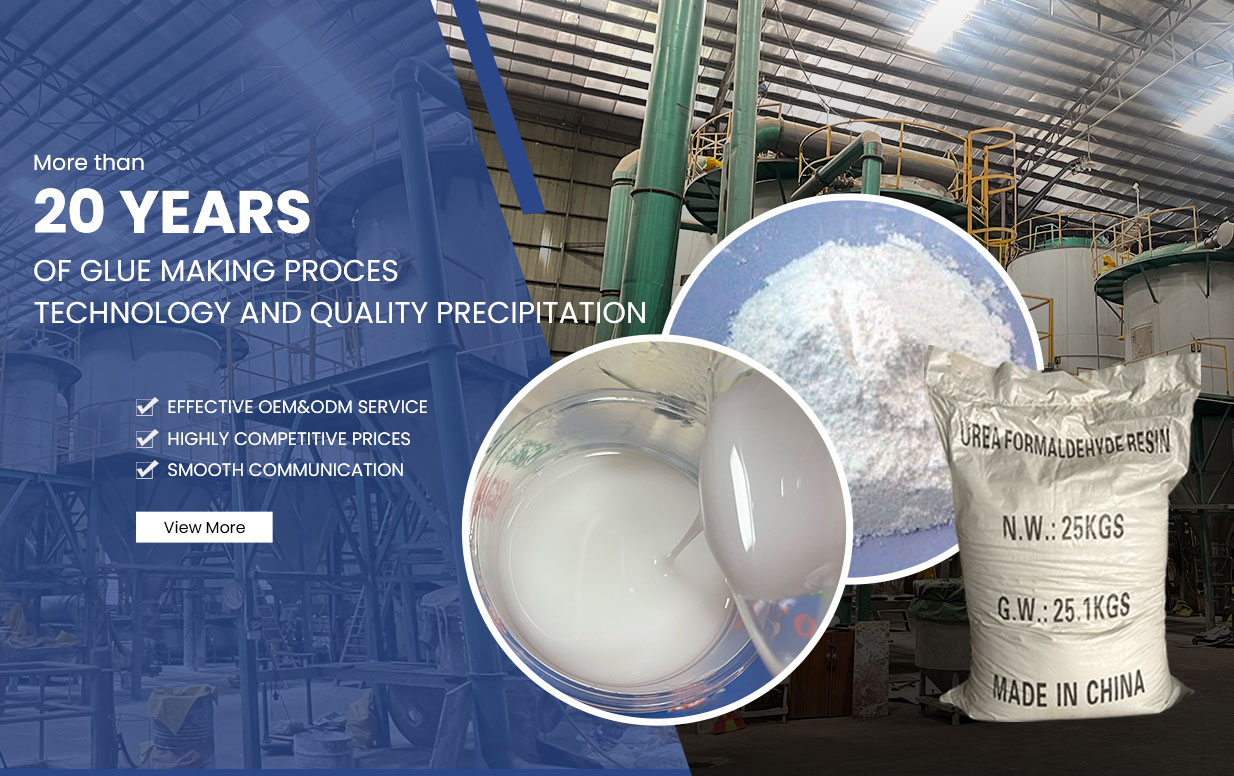
GOODLY, operated by Foshan Yongliyuan New Material Co., Ltd., specializes in Urea Formaldehyde Resin Powder and presents itself as a manufacturer with more than 20 years of glue-making experience, product customization capability, and ongoing technology upgrades. Its product range covers particleboard, plywood, density board, and other related panel applications, which suggests broader familiarity with different wood-panel process requirements. For particleboard producers, the practical advantage is not just having a resin powder available, but having a supplier that can discuss moisture range, catalyst dosage, hot pressing parameters, and application rate in a usable way.
For high-volume production, the best UF resin powder is usually the grade that creates the most predictable manufacturing result. Strong bonding matters, but it must be paired with a cure speed that fits the press cycle and a total cost structure that holds up over time. Emission compliance also has to be built into the decision from the beginning, especially for regulated export markets. When a supplier can provide clear operating ranges, shelf-life guidance, blending instructions, and formulation flexibility, resin selection becomes a tool for process control rather than a purchasing gamble. That is where GOODLY stands out: it combines manufacturing experience with application-level guidance that helps particleboard lines run more steadily, more efficiently, and with fewer quality surprises.