jianguli@goodlyglue.com
+86-18948072250

Furniture durability is often decided inside the panel, not on the surface. When particleboard, MDF, HDF, or plywood is pressed, the adhesive system determines whether the board keeps its strength, stays flat, and holds fasteners after years of daily stress. In that system, Urea Formaldehyde Resin Powder plays a central role by creating a rigid bonded network that locks wood particles and fibers together during hot pressing.
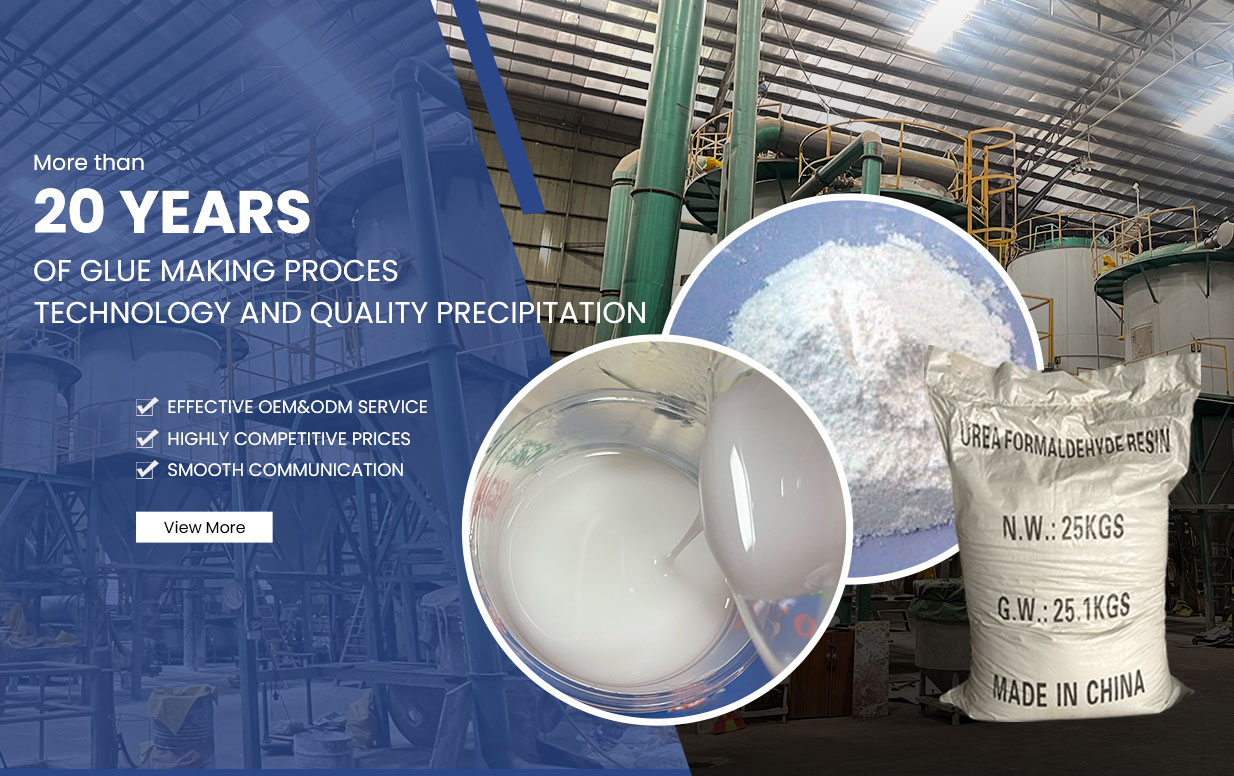
GOODLY manufactures urea formaldehyde resin powder in Foshan, one of China’s major furniture production hubs, with more than 20 years of glue making experience and a focus on customization and stable batch consistency for continuous panel lines.
Durability problems in furniture panels usually show up as corner cracking, edge chipping, screw stripping, bubbling after humidity exposure, or gradual warping. These failures are closely tied to internal bond strength and stress transfer across the wood and resin interface. Formaldehyde based resins dominate wood based panel production globally, largely because they cure fast and deliver rigid, high strength bonds suited to flat panels used in furniture structures.
A well designed UF adhesive system improves durability through three mechanisms:
Stronger internal bonding that resists delamination and edge failure under cyclic loads
Higher structural rigidity that reduces creep and long term sagging in shelves and carcass panels
Better dimensional stability by stabilizing the wood particle network and limiting springback after pressing
In furniture grade particleboard, Particleboard uf resin powder forms the bonding bridges between discrete particles during press closure and cure. This improves strength and stability by tightening the internal structure, which directly supports durability in high wear furniture components like cabinet sides, shelves, and drawer parts.
A practical way to judge whether durability is improving is to track standardized panel targets. For EN 312 type P2 interior furniture boards, the minimum internal bond strength is commonly referenced at 0.35 N per mm², with bending property thresholds also defined for typical thickness ranges.
Resin powder performance depends on how consistently it dissolves, wets wood, and cures under press conditions. GOODLY provides manufacturing level parameters that help plants stabilize output, including recommended timber moisture, press ranges, and curing agent dosage guidance.
Key control points that translate to durability:
Moisture control in furnish GOODLY lists an optimal timber moisture target of 8 to 10 percent with a controlled tolerance window, which helps avoid weak bond lines caused by over wet mats or brittle glue lines caused by overly dry furnish.
Press temperature and pressure discipline GOODLY provides a hot pressing temperature window and pressure range as part of its process guidance for stable curing and bond development. Keeping these conditions stable reduces under cure zones that later become crack initiation points.
Curing agent dosing A controlled curing agent addition range supports predictable gel time and press factor, helping boards reach target strength with fewer press surprises. (GOODLY)
Powder consistency and screening GOODLY notes typical particle size control in the 80 to 120 mesh range for powdered UF resin, which supports consistent dissolution and viscosity, improving glue distribution and reducing starved bond zones.
To turn resin selection into furniture durability, the checks below should be treated as release gates, not optional tests:
| Checkpoint | What it protects | Typical verification method |
|---|---|---|
| Resin dissolution and viscosity stability | Prevents glue lumps and weak spots | Timed mixing check and visual homogeneity |
| Gel time consistency | Prevents under cure and brittle cure extremes | Plant gel time test aligned to press factor |
| Internal bond strength trend | Prevents delamination and edge blowouts | IB testing aligned to EN 312 targets |
| Formaldehyde compliance readiness | Prevents blocked shipments and relabel risk | TSCA Title VI emission limits and labeling readiness |
For export facing furniture programs, composite wood compliance is frequently a gating requirement. Under TSCA Title VI, U.S. regulated composite wood panels have defined emission limits, including 0.09 ppm for particleboard and 0.11 ppm for MDF, along with third party certification and labeling expectations.
Panel plants and furniture OEM lines typically need more than a generic adhesive powder. GOODLY positions its UF Resin Powder portfolio around predictable throughput, consistent batching for high volume lines, and customization readiness for different density targets, thickness ranges, and working time needs.
GOODLY also publishes clear product level parameters, including model references, shelf life guidance, and process recommendations that help production teams shorten trial cycles and stabilize board performance.
Resin powder improves furniture durability by strengthening internal bonding, increasing structural rigidity, and stabilizing the board network under real press conditions. When resin selection is paired with disciplined moisture control, curing control, and release gate testing, durability becomes repeatable at scale. GOODLY supports this outcome with manufacturing oriented UF Resin Powder specifications, customization capability, and process guidance designed for stable panel production and export compliant furniture supply.
US EPA TSCA Title VI formaldehyde emission standards and compliance framework
Research review on dominance of formaldehyde based resins in wood based panels
EN 312 furniture grade particleboard minimum internal bond strength reference
GOODLY published product and process parameters, particle size range, and manufacturer profile