jianguli@goodlyglue.com
+86-18948072250

Door panel lamination requires an adhesive that can maintain reliable contact across a relatively large surface while supporting later trimming, drilling, routing, transport, and installation. Wood Adhesive Resin Powder is commonly considered for heat-pressed wood-based laminations, but the suitable formulation depends on the face material, core structure, moisture exposure, press system, and required finished-door performance.
A door panel may combine plywood, MDF, particleboard, solid wood strips, veneer, decorative paper, or other facing materials. Each construction places different demands on the glue line.
MDF provides a smooth surface but can absorb moisture through exposed areas. Particleboard requires good contact across particles of different sizes. Plywood may contain thickness variation or internal stress, while natural veneer changes dimension as moisture conditions shift. The adhesive must be tested with the complete door structure rather than with one material alone.
A suitable door panel lamination adhesive should spread evenly, remain workable during assembly, and cure within the available press cycle. It also needs enough bond strength to withstand machining forces and normal environmental changes.
Important characteristics include:
Consistent viscosity after mixing
Suitable working and assembly time
Uniform transfer to both bonding surfaces
Predictable curing under heat and pressure
Compatibility with the selected core and face
Stable performance after conditioning and machining
The strongest laboratory bond is not automatically the most efficient factory choice. An adhesive with an extremely short working period may cure before a large door assembly reaches the press, increasing the risk of weak edges and local delamination.
Press temperature, pressure, and time must be matched to door thickness and material conductivity. A thick composite door takes longer for heat to reach the internal glue line than a thin flat panel. Surface temperature alone does not confirm that the adhesive inside has cured.
Uneven door thickness can also reduce contact. Before lamination, factories should inspect core flatness, surface cleanliness, sanding quality, and moisture content. Dust and loose fibers create a weak boundary even when the resin itself performs correctly.
| Control Point | Risk When Uncontrolled | Verification Method |
|---|---|---|
| Core moisture | Blistering or dimensional movement | Moisture measurement |
| Glue viscosity | Uneven coating or penetration | Batch viscosity check |
| Spread rate | Dry areas or excessive squeeze-out | Weight or coverage inspection |
| Assembly time | Premature drying | Timed production records |
| Press uniformity | Weak corners and edges | Pressure and platen checks |
| Conditioning | Delayed warping or separation | Post-press inspection |
The manufacturer should receive information about the door core, face material, target size, press conditions, expected output, and destination environment. This allows the adhesive grade and preparation guidance to be aligned with the actual application.
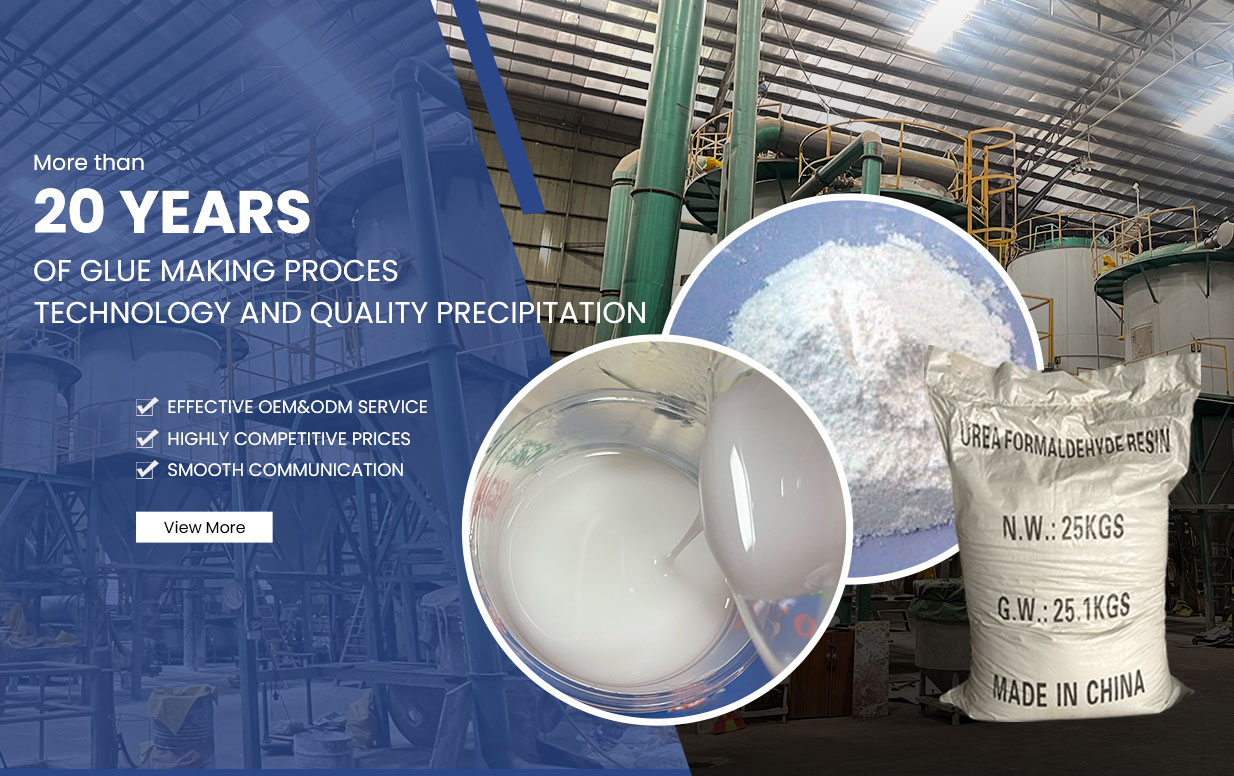
GOODLY supplies powdered UF and muf resin products for different wood-bonding uses. Where greater moisture resistance is required, the formulation should be evaluated against the relevant door performance standard rather than selected only by product name.
A laminated door may look acceptable after pressing but fail when hinges, locks, grooves, or edge profiles are machined. Trial evaluation should therefore include cutting, routing, drilling, and edge inspection. Peel or bond tests from the center, corners, and edges can expose pressure or coating variation.
Door manufacturer procurement buyers should also compare results after a defined conditioning period. Samples tested while still warm may not reveal delayed veneer movement, moisture imbalance, or incomplete internal curing.
Reliable door lamination depends on more than adhesive strength. The resin powder must fit the panel materials, available assembly time, press capability, machining sequence, and service conditions. A controlled trial using the intended door structure provides more useful purchasing evidence than a generic adhesive sample or isolated technical value.