jianguli@goodlyglue.com
+86-18948072250

Particleboard remains one of the most efficient wood panel solutions for furniture, interior fit-out, and value-driven panel production. At the center of this process, UF resin has stayed dominant because it matches the technical and commercial needs of large-scale board manufacturing very well. It cures quickly, bonds wood particles effectively, supports stable pressing cycles, and helps factories control production cost without sacrificing basic board performance for interior use. These advantages explain why UF systems continue to be the standard choice across much of the global particleboard manufacturing industry.
Particleboard is made from wood particles of different sizes that must be bonded into a board with reliable internal strength and a consistent structure. In this environment, the adhesive is not only a bonding material. It also affects press speed, board quality, thickness stability, surface finish, and overall plant efficiency. UF resin is widely used because it performs well across these critical control points. It offers strong adhesion, fast reaction under heat, and practical processing behavior for continuous production lines.
Another major reason is cost balance. In board plants, adhesive consumption directly affects manufacturing economics. UF resin has long been valued for combining dependable bonding performance with relatively low cost. Compared with several alternative wood adhesive systems, it supports shorter press cycles and lower curing temperatures, which helps reduce energy demand and improve output per shift. This is especially important for factories producing standard interior-grade boards in high volume.
Speed matters in particleboard plants. UF resin is known for high reactivity and fast curing under hot pressing conditions, which helps shorten press time and stabilize production rhythm. A faster cure allows manufacturers to keep lines moving efficiently and reduce bottlenecks between blending, mat forming, pressing, and finishing. This is one of the strongest reasons why UF remains the preferred resin for many interior board applications.
A well-formulated UF system can create strong bonding between wood particles and contribute to internal bond strength, dimensional consistency, and surface integrity. For particleboard used in cabinets, shelves, office furniture, and decorative panels, this performance level is often sufficient when the board is designed for dry interior service. The nearly colorless glue line is another advantage because it works well with surface finishing and lamination processes.
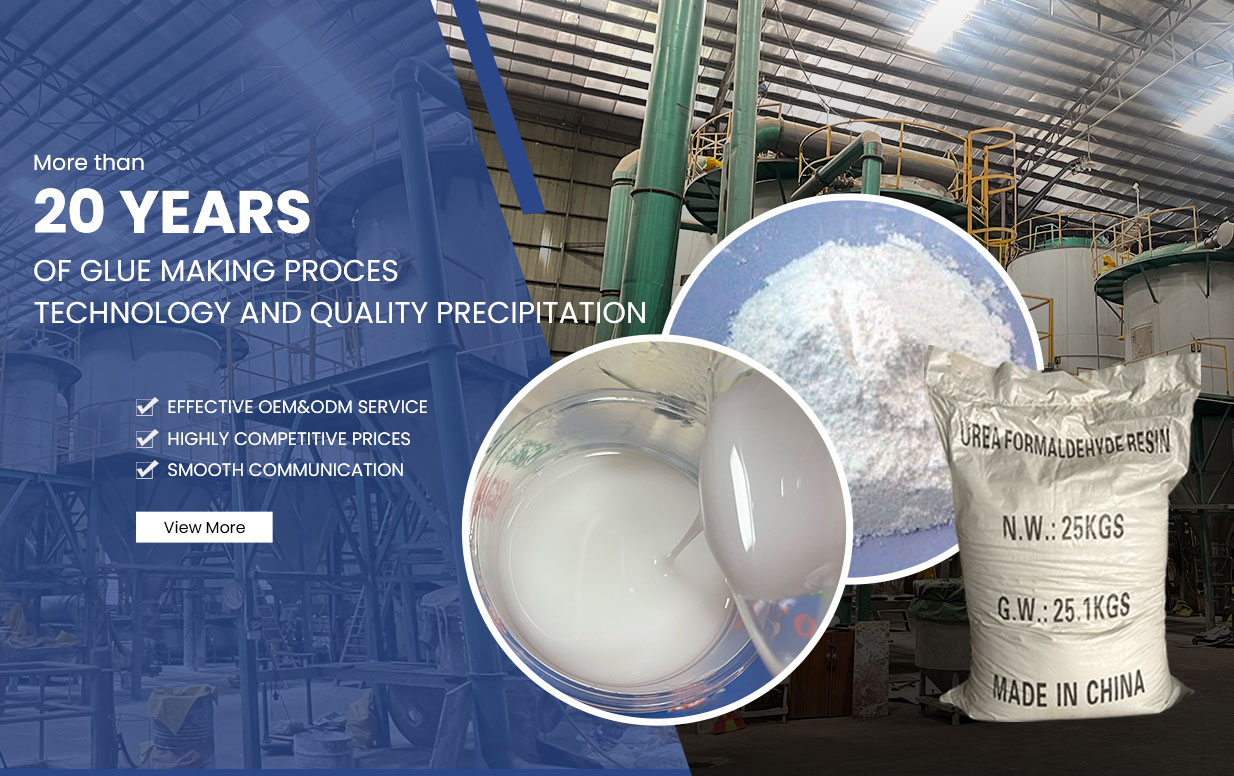
For many manufacturers, powder systems offer storage and handling advantages. GOODLY focuses on Urea Formaldehyde Resin Powder and highlights customized formulations for different customer needs, backed by more than 20 years of glue-making experience and ongoing technology upgrades. On its particleboard grade, GOODLY lists operating parameters such as hot-pressing temperature of 80 to 120 degrees Celsius, pressure of 8 to 16 kg per square centimeter, and a shelf life of 1 year. These clear processing windows help buyers evaluate whether the material matches their existing board line and press conditions.
The reason is not only technical performance. It is also process compatibility. Particleboard factories need adhesives that can work with different wood particle blends, moisture levels, press schedules, and board thickness targets. GOODLY states that its particleboard resin is designed to improve strength and stability while supporting high-volume production and practical use with additives and adjusted mix ratios. That kind of flexibility matters in real manufacturing, where conditions change with season, raw material source, and board specification.
UF resin also supports a favorable balance between panel quality and cost efficiency. In commercial production, the best adhesive is not always the one with the highest theoretical performance. It is the one that delivers repeatable results at the right cost for the intended board grade. For interior particleboard, UF resin often meets that requirement better than more expensive alternatives. That is why it remains deeply established in mainstream board production.
GOODLY presents itself as a specialized manufacturer of urea formaldehyde resin powder based in Foshan, with roots going back to 1998 and more than 20 years of glue-making experience. The company emphasizes customization, technology upgrades, and product reliability, while offering grades for plywood, particleboard, density board, flooring applications, and related wood-based uses. For buyers, this matters because adhesive supply is not only about price. It is about formulation stability, technical matching, and a supplier’s ability to support consistent output across different panel applications.
A suitable particleboard adhesive resin should fit the board structure, target density, moisture control strategy, and press schedule of the customer. GOODLY’s published data shows attention to these practical factors, including timber moisture range, curing agent dosage, coating quantity, and activity period after blending. This kind of information helps purchasing teams and technical teams discuss more than a generic glue offer. It supports evaluation based on factory conditions and production goals.
Its popularity does not mean UF is the right answer for every board type. Industry literature consistently notes that UF resin has limited moisture resistance compared with some alternative systems, which is why it is mainly used in interior and non-structural wood panels. Formaldehyde emission control is another critical issue. Modern buyers increasingly pay attention to compliance, low-emission targets, and formulation improvements that help meet stricter environmental expectations. This makes supplier selection more important, not less.
For this reason, resin sourcing should go beyond a basic quotation. Buyers should review curing behavior, storage stability, emission strategy, suitability for board thickness range, and support for consistent panel properties after pressing and sanding. A good wood panel glue powder supplier should be able to explain how its formulation performs in real production instead of only listing a product name.
| Factor | Why UF Resin Is Widely Used In Particleboard |
|---|---|
| Cost efficiency | Helps control adhesive cost in large-volume board production |
| Fast cure | Supports shorter press cycles and higher throughput |
| Bonding performance | Provides reliable internal bonding for interior particleboard |
| Processing convenience | Works well with hot pressing and established factory systems |
| Surface appearance | Nearly colorless glue line suits finishing and lamination |
| Supply practicality | Available in formulations tailored to different board needs |
The continued use of resin for particleboard production is rooted in a simple fact: UF resin matches the economics and operating rhythm of mainstream board plants better than most alternatives for standard interior applications.
UF resin is widely used in particleboard because it brings together fast curing, dependable bonding, practical processing, and competitive manufacturing cost. Those strengths are closely aligned with what board producers need every day on the factory floor. GOODLY’s focus on customized uf resin powders, long production experience, and clearly published processing data adds further value for buyers seeking more stable adhesive performance in the particleboard sector. For companies comparing suppliers, the real question is not only why UF remains common, but which formulation partner can help deliver consistent board quality with less production risk.
Previous:
Next: How to Choose Wood Adhesive for Furniture Manufacturing?