jianguli@goodlyglue.com
+86-18948072250

For panel producers, the question is rarely about emissions alone. The real challenge is lowering formaldehyde release without sacrificing press efficiency, bond integrity, and finished-board stability. That is why Muf resin powder remains a practical route for manufacturers targeting stricter emission grades. China’s current grading standard GB/T 39600-2021 has been in force since October 1, 2021, and classifies formaldehyde emission for wood-based panels and finishing products. A recent technical review notes that Chinese E1 aligns with the European E1 threshold of 0.124 mg per cubic meter, while Chinese E0 covers panels above 0.025 mg per cubic meter and up to 0.050 mg per cubic meter.
MUF is not a miracle shortcut. It works because melamine changes the resin network in a way that can reduce free formaldehyde while improving moisture resistance compared with standard UF systems. Published research comparing UF and MUF in wood bonding shows that MUF formulations can maintain competitive adhesion performance, and a U.S. Forest Service study found that increasing melamine content reduced formaldehyde emission while also improving internal bond strength, lowering thickness swell, and reducing water absorption.
This matters in real production. When a plant switches from conventional UF toward a well-controlled MUF system, the goal is not simply to chase a lab value. The goal is to achieve a stable process window across raw board moisture, press temperature, catalyst level, spread rate, and storage conditions. Literature on plywood and particleboard repeatedly shows that melamine-modified systems can lower formaldehyde release while preserving, and in many cases improving, bond performance under demanding conditions.
Passing E1 is already a baseline target in many export-oriented panel applications. Reaching E0 requires tighter process discipline because the allowable emission range is much lower. In practice, resin choice is only one part of the equation. Board density profile, hot pressing, post-curing behavior, wood species, moisture content, and scavenger use can all influence final results. That is why experienced manufacturers focus on the full adhesive system rather than a single raw material claim.
A simple comparison makes the target clearer:
| Grade | Formaldehyde emission limit |
|---|---|
| Chinese E1 | up to 0.124 mg per cubic meter |
| Chinese E0 | above 0.025 and up to 0.050 mg per cubic meter |
| Chinese ENF | up to 0.025 mg per cubic meter |
These thresholds are widely used as reference points when buyers evaluate decorative panels, furniture boards, flooring substrates, and interior materials.
Research does support the article title. One particleboard study reported that MUF-bonded boards achieved lower formaldehyde emission than UF-bonded boards while also delivering stronger board performance under the tested formulation. Another study on melamine-modified UF systems found that melamine addition reduced emission and improved glue-bond quality metrics such as internal bond strength and dimensional stability. A separate review comparing UF and MUF bonding behavior concluded that MUF systems offer a useful balance of lower emission potential and durable adhesion in wood composites.
That pattern is exactly why muf resin powder is often chosen when manufacturers must balance compliance and productivity. It helps shift the formulation away from the common trade-off where lower emissions come at the expense of bond reliability. The benefit is especially valuable for boards that also need better moisture resistance, decorative stability, or reliable press performance in volume production.
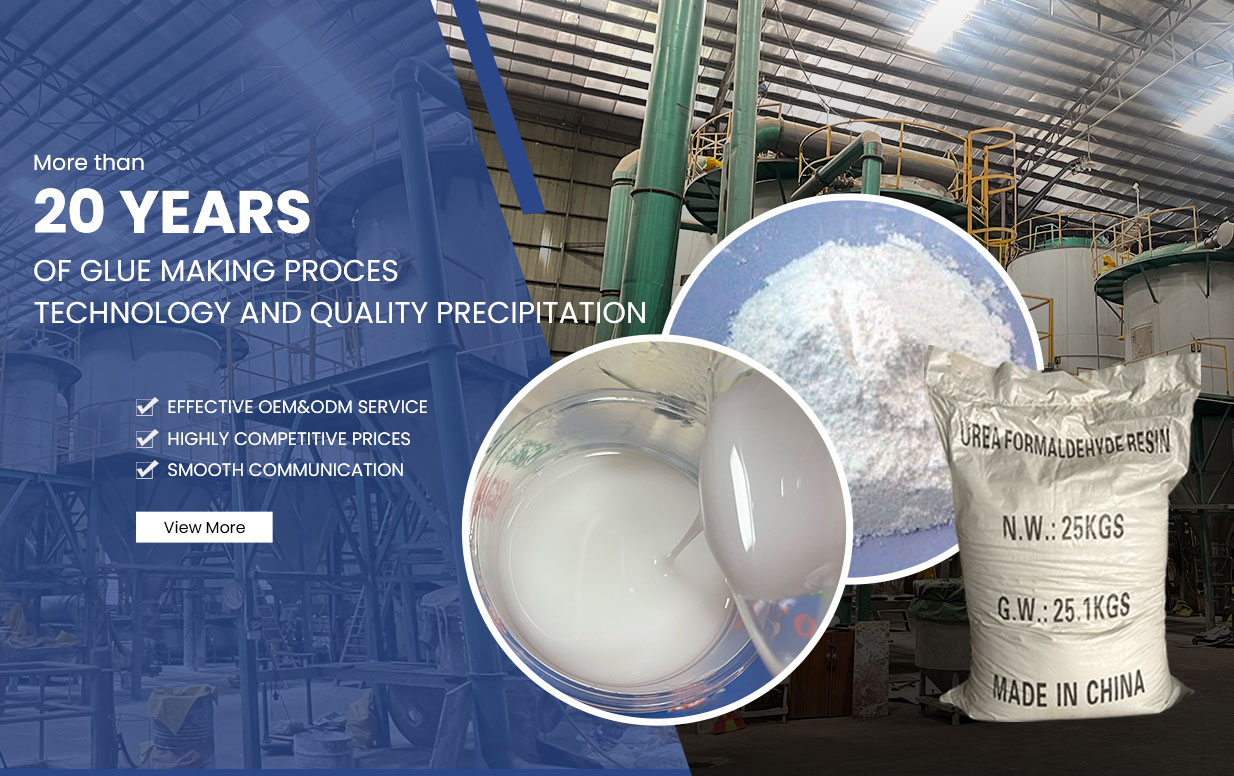
On the GOODLY platform, the company behind the production base is Foshan Yongliyuan New Material Co., Ltd., a manufacturer focused on Urea Formaldehyde Resin Powder and related adhesive materials. The site states that the company has more than 20 years of glue-making experience and continues upgrading technology and equipment to meet changing market needs. Its product range includes MUF resin powder and Formaldehyde Decomposer products, which is important for plants that need not only a base resin but also practical support for stricter environmental targets.
From a manufacturing standpoint, GOODLY’s advantage is not just selling a powder. It is the ability to support a broader adhesive strategy. MUF resin powder on the site is positioned for wood processing and decorative paper impregnation, while the formaldehyde decomposer line is described as a way to reduce excess formaldehyde in the finished board. For buyers evaluating long-term supply, that combination is more useful than sourcing a single material in isolation because it supports both bonding performance and emission control at the system level.
Using MUF resin powder is a strong starting point, but passing consistently depends on execution. Manufacturers usually see better results when they control resin preparation, mixing uniformity, catalyst dosage, wood moisture, hot-press conditions, and post-production conditioning. Even with a stronger resin system, poor control upstream or downstream can push emission values higher than expected. Published work on plywood confirms that process variables such as veneer moisture and sealing conditions can materially affect both bond behavior and formaldehyde release.
A practical sourcing decision, then, is to look for a supplier that understands resin chemistry and panel manufacturing at the same time. GOODLY’s product structure points in that direction. The site presents MUF powder for flooring, decorative paper, and wood-related uses, alongside emission-reduction auxiliaries, which fits the way real factories solve compliance problems.
MUF resin powder can help you pass E0 and E1 standards, and the strongest evidence comes from published panel studies rather than marketing language alone. The reason is straightforward: melamine-modified systems can reduce formaldehyde emission while keeping bonding strength at a commercially useful level. For manufacturers that need a more reliable route to lower-emission boards without giving up production performance, GOODLY offers a relevant combination of resin manufacturing experience, MUF product coverage, and formaldehyde-control support.