jianguli@goodlyglue.com
+86-18948072250

For plywood and particle board factories, formaldehyde control is no longer a secondary specification. It affects qualification, export continuity, labeling, inspection records, and customer trust. CARB Phase 2 set strict emission caps for hardwood plywood, particleboard, and MDF, and the U.S. EPA later aligned federal TSCA Title VI limits to the same levels. The current caps are 0.05 ppm for hardwood plywood, 0.09 ppm for particleboard, 0.11 ppm for MDF, and 0.13 ppm for thin MDF. Since March 22, 2019, regulated panels and finished goods entering the U.S. market must be certified and labeled as TSCA Title VI compliant.
This matters in practical production. A panel can look strong, press well, and machine cleanly, yet still fail because emission performance is unstable from batch to batch. CARB designed the regulation around this risk. California states that the rule covers hardwood plywood, particleboard, MDF, and finished goods containing them, while the EPA requires third-party certification, product labeling, and recordkeeping so only compliant panels enter the supply chain.
Low formaldehyde UF resin powder can meet CARB Phase 2 when compliance is treated as a full process target rather than a simple resin claim. That means the resin must support low free formaldehyde behavior, stable curing, repeatable glue preparation, and predictable press performance under real mill conditions. The panel plant then has to connect that resin system to controlled moisture, dosing, hot pressing, internal quality checks, and third-party verification. In other words, compliant output comes from a controlled manufacturing system, not from a marketing phrase on a bag.
Many factories first think about the cap value, but the regulation goes beyond the final ppm number. EPA notes that manufacturers, importers, fabricators, distributors, and retailers are all affected. Products must be tested, certified, and labeled correctly. CARB also requires compliant documentation and allows enforcement through facility inspections, records audits, and compliance testing. This is why a factory that only chases low test values without process discipline still faces rejection risk.
CARB’s long-term objective explains why low-emission chemistry matters so much. California estimated formaldehyde emissions from hardwood plywood, particleboard, and MDF at about 900 tons per year before the measure, and projected Phase 2 would cut that by about 58 percent, or roughly 500 tons per year. The regulation was built to push real emission reduction across manufacturing, not only paperwork compliance.
UF systems remain widely used because they offer fast curing, efficient processing, and strong bonding economics for wood-based panels. The key change is that mills now need optimized low-emission UF chemistry rather than conventional high-emission formulations. CARB’s own fact sheet noted that optimization of urea-formaldehyde resins was underway to allow more cost-effective formulations capable of meeting Phase 2 standards. That point is important for production planners: compliance does not automatically require abandoning UF chemistry, but it does require a better-formulated UF system and tighter process control.
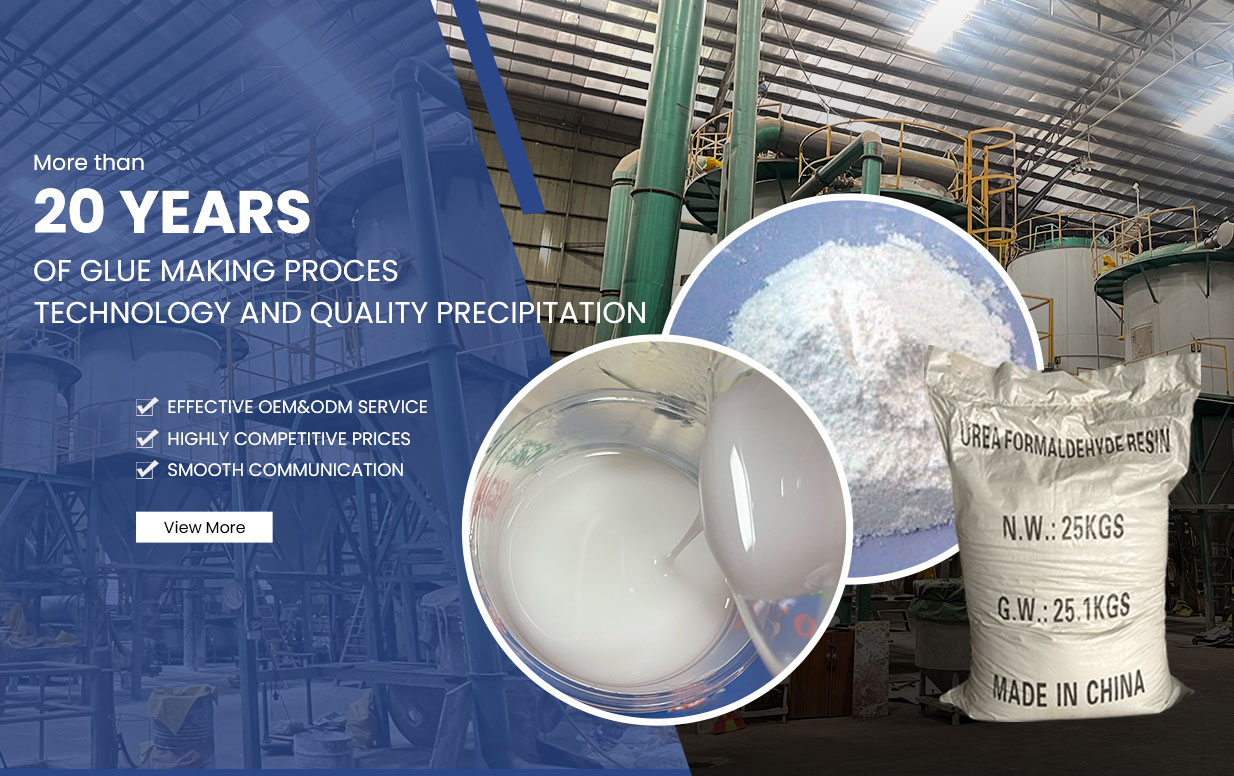
GOODLY is positioned around that manufacturing reality. Its site presents the company as a Foshan-based manufacturer focused on Urea Formaldehyde Resin Powder, with more than 20 years of glue-making experience, customized products, continuous technology upgrades, and product lines for plywood, particleboard, and density board applications. That range is important because compliance work is never identical across veneer plywood, particleboard, and fiberboard processes.
A compliant resin must first reduce the likelihood of excess formaldehyde release during pressing and after board production. GOODLY states that its low-emission UF and MUF resin systems can reach E0 or CARB-compliant levels, while its powder products are designed for plywood, particleboard, and MDF manufacturing. The company also states that its powder UF resin has low moisture content and low free formaldehyde content and is intended to meet environmental requirements. Those statements align with what mills need most: controlled chemistry that supports both production efficiency and emission discipline.
A second requirement is curing stability. GOODLY lists typical hot pressing conditions of 80 to 120 degrees Celsius, pressure of 8 to 16 kilograms per square centimeter, and about 1 minute per millimeter of board thickness for several UF powder products. Those parameters matter because incomplete cure or unstable press conditions can increase variability in final board quality and emissions. A resin system that performs within a clear operating window is easier to standardize across shifts and production lines.
A third requirement is shop-floor consistency. GOODLY’s published instructions specify a repeatable mixing approach using 25 kilograms of water for 25 kilograms of resin powder, split into two water additions, plus controlled curing agent addition of 2 to 5 per thousand of blended glue. Published preparation discipline is not a small detail. In many mills, formaldehyde failures come from uncontrolled dilution, inconsistent catalyst addition, or unstable glue age rather than from resin chemistry alone.
The table below shows why resin selection should be matched to the actual regulated panel category.
| Product category | Emission cap |
|---|---|
| Hardwood plywood | 0.05 ppm |
| Particleboard | 0.09 ppm |
| MDF | 0.11 ppm |
| Thin MDF | 0.13 ppm |
These limits are identical under CARB Phase 2 and EPA TSCA Title VI. A plywood mill therefore cannot use a particleboard-style compliance mindset. Hardwood plywood has the tightest cap, so resin selection, veneer moisture, spread rate, press schedule, and panel conditioning all need tighter control.
For particleboard and MDF plants, the challenge is often different. The allowed caps are slightly higher than hardwood plywood, but the furnish is more heterogeneous and line output is usually larger. CARB’s comparison table notes that for particleboard and MDF, quality control testing is required at least once per 8 or 12 hour shift of operation. That reflects the real manufacturing risk: high-volume production can drift quickly if resin dosage, fiber or chip moisture, temperature, or press response shifts during the day.
Factories that want fewer rejections usually control at least five variables together: resin formulation, wood moisture, glue mix stability, hot press parameters, and lot-by-lot quality records. When one of these moves, the board may still pass internal physical testing while moving closer to the formaldehyde limit. That is where a low formaldehyde UF powder from a manufacturer with stable application data becomes valuable. GOODLY publishes application ranges for timber moisture at about 8 to 10 percent, press temperature at 80 to 120 degrees Celsius, and shelf life at 1 year, which helps mills establish more disciplined standard operating windows.
GOODLY’s advantage is not only that it sells UF powder. It presents itself as a manufacturer focused on customized resin products, technical upgrading, and application-specific supply for plywood, particleboard, MDF, veneer, and related wood processing. That is useful because compliant production often requires adaptation to board structure, local raw material, press line speed, and customer-facing panel grades. A one-formula approach rarely works across every mill.
Its product range also indicates that the company understands multiple panel scenarios rather than a single commodity grade. The site lists plywood uf resin powder, High-Strength Particleboard UF Resin Powder, density board UF resin powder, and other specialty adhesive powders. For mills trying to avoid costly rejections, this matters because the best resin choice should reflect board construction and downstream use, not only purchase price.
GOODLY also highlights customized products for specific customer needs and more than 20 years in urea formaldehyde resin powder. In panel manufacturing, experience matters because compliance is usually solved through adjustment, not theory. Plants often need help balancing cure speed, spreadability, board strength, line efficiency, and emission results at the same time. A supplier that can discuss application details is more useful than one that only offers a generic low-emission claim.
A mill that wants to reduce rejection risk should think in this order:
Confirm whether the panel is hardwood plywood, particleboard, MDF, or thin MDF, then build the target around the relevant cap. The difference between 0.05 ppm and 0.09 ppm is large in compliance terms. Misclassifying the panel type or using the wrong internal benchmark can create avoidable failures.
A low formaldehyde UF powder should fit the actual board structure and production method. GOODLY’s published ranges for temperature, pressure, catalyst addition, and glue preparation give plants a clearer starting point for line trials and process standardization.
Water ratio, catalyst level, mixing sequence, and glue pot life should be fixed and logged by shift. GOODLY’s instructions provide a defined water addition sequence and curing agent range, which supports repeatability in production.
CARB and EPA frameworks rely on testing, certification, records, and labeling. Internal test trends should therefore be watched continuously, not only when a customer asks for documents. EPA also requires three years of records under TSCA Title VI, which shows how seriously traceability is treated in the supply chain.
Low formaldehyde UF resin powder can meet CARB Phase 2, but only when the chemistry, process window, and compliance system are aligned. The law is strict, the emission caps are clear, and the commercial cost of rejection is real. For plywood and particle board factories, the best route is to use a low-emission resin designed for the right board type, keep the glue system stable, control press conditions tightly, and maintain reliable certification records.
GOODLY’s positioning fits that need well. The company focuses on UF resin powder manufacturing, publishes usable processing parameters, supports plywood, particleboard, and density board applications, offers customized products, and emphasizes long-term technical upgrading. For factories trying to stay compliant while keeping production efficient, that combination is far more valuable than a low-price adhesive with uncertain emission performance.