jianguli@goodlyglue.com
+86-18948072250

Veneer bonding looks simple, but adhesion failures usually come from small process gaps: moisture out of range, uneven glue film, incorrect mix viscosity, or a press cycle that does not fully cure the resin through the panel. With the right controls, a resin glue system can deliver a rigid, stable glue line that keeps decorative veneer flat, tight, and resistant to edge lifting over time. GOODLY develops uf resin powder systems designed for veneer lamination and wood panel production, with parameters that make process control repeatable at scale.
Adhesion begins with what the resin is asked to bond. For decorative veneer work, keep timber moisture in a narrow window and make sure the veneer and substrate are conditioned to the same environment before spreading glue. GOODLY’s veneer-grade uf resin guidance targets wood moisture at 8–10 percent with a small tolerance, which helps avoid two common issues:
Over-dry veneer that pulls resin too fast and leaves a starved glue line
Over-wet veneer that releases steam under heat and creates blisters or weak spots
Surface preparation matters as much as moisture. Sand or calibrate the substrate to a uniform texture, remove dust, and avoid oily contamination that blocks wetting. Veneer should lay flat without internal stress; tensioned veneer often “wins” against a weak or under-cured glue line.
powdered uf resin is sensitive to mixing order and water ratio. A practical baseline is:
Resin powder: 100 parts by weight
Water: 50–65 parts by weight
This range supports workable viscosity while keeping solids high enough for a strong glue line.
For consistent results, add water first, then introduce powder slowly while stirring. GOODLY recommends controlled agitation, including keeping mechanical mixing under about 2,000 rpm and mixing for roughly 3–5 minutes to eliminate lumps and ensure full wet-out.
Curing agent control is the next lever. For veneer bonding, GOODLY notes a typical curing-agent addition of 2–5 per mille of the already blended glue. With curing agents, the active period can drop to about 3 hours, which supports faster cycles but demands disciplined batch timing. Without curing agent, the working window can extend significantly, which is useful for longer layups but requires press settings that still achieve full cure.
A strong veneer bond needs a continuous, even adhesive film. GOODLY’s veneer-grade UF resin reference coating quantity is typically 150–180 g per square meter on one side, adjusted for the plate texture and smoothness. Too low creates dry spots; too high increases steam risk and squeeze-out, and can telegraph through thin veneer.
Practical film-quality checks on the line:
Look for uniform sheen with no “dry islands”
Check roller or doctor settings every shift
Monitor viscosity drift as temperature changes during the day
UF resin needs heat and pressure to cure properly through the assembly. For decorative veneer lamination, GOODLY recommends:
Hot-press temperature: 80–120°C
Hot-press pressure: 8–16 kg/cm²
Pressing time: about 1 minute per mm of plate thickness
Use these values as a controlled starting point, then fine-tune based on veneer species, core density, and line speed. If you see blisters, reduce moisture variation and avoid excessive glue add-on before lowering press temperature. If you see edge lifting or brittle failure at the glue line, increase cure completion by tightening time-temperature control and verifying catalyst dosing.
Improvement needs repeatable testing. Wood adhesive bonds are commonly evaluated with standardized shear methods such as ASTM D905, as well as EN 205 and EN 302-1 style approaches used for solid wood and bonded assemblies. Using a consistent method makes it much easier to connect process changes to real strength outcomes instead of visual impressions.
A useful internal routine is to test:
Early strength after cooling
Strength after conditioning in controlled humidity
Failure mode, wood failure versus glue-line failure
| Symptom | Likely cause | What to adjust first |
|---|---|---|
| Blistering after press | Excess moisture, too much glue, trapped vapor | Bring wood moisture back to target range, reduce spread, improve preconditioning |
| Veneer edge lifting | Under-cure, low pressure, short time | Increase cure completion using the time-per-thickness rule, verify pressure uniformity |
| Starved bond, dry spots | Viscosity too high, uneven spread, over-absorbent core | Adjust water ratio within 50–65 parts range, recalibrate rollers, seal or smooth core surface |
| Lumps and streaks | Poor mixing sequence, high rpm entrainment | Add powder slowly into water, keep mixing controlled, extend mix to full dispersion |
| Inconsistent strength by shift | Pot life exceeded, catalyst drift, temperature swings | Batch smaller, track active period, standardize catalyst dosing and glue temperature |
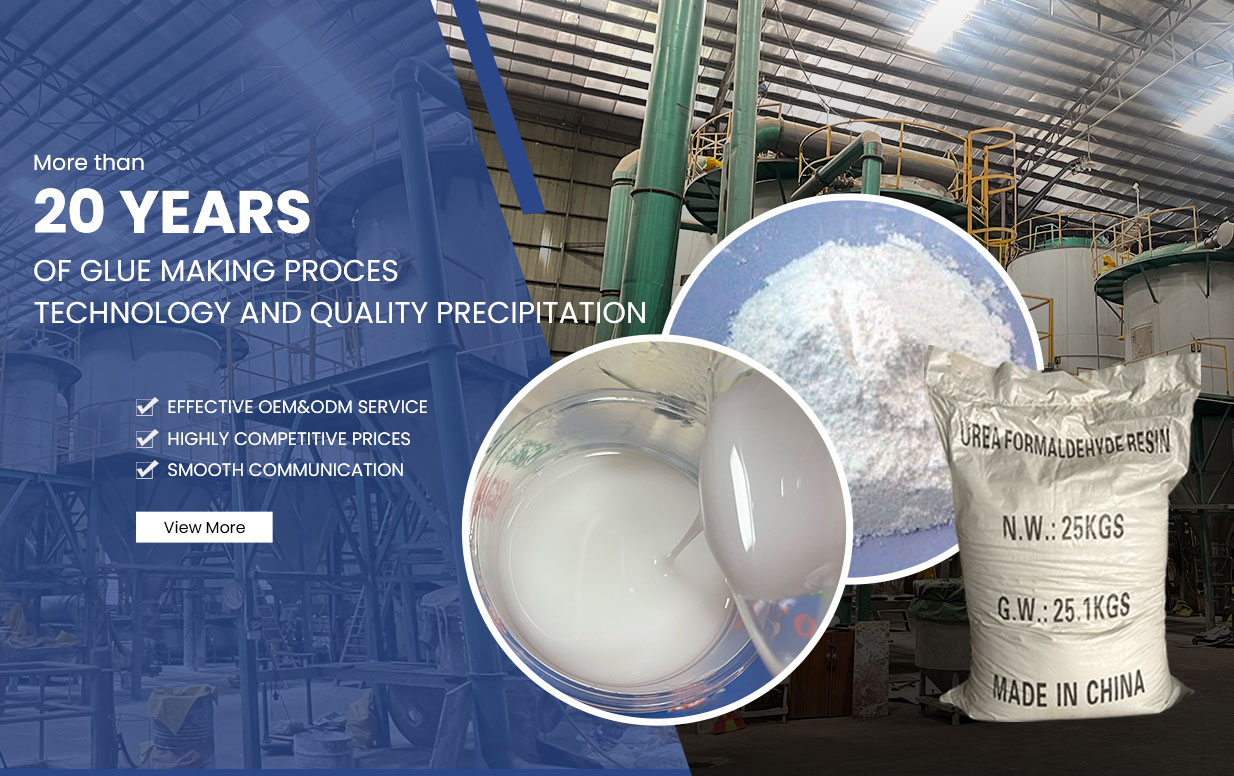
For veneer lines, the value is not only resin chemistry but how predictable the system is in daily production. GOODLY positions its uf resin powder portfolio around controlled hot-press bonding, clear operating ranges, and mixing guidance that helps plants standardize results across shifts. The company also highlights customized product development and long experience in UF resin powder manufacturing, which is useful when your press cycle, veneer species, or substrate structure needs a tuned formulation. This supports OEM/ODM projects and wholesale supply where repeatability and documentation matter as much as bond strength.
If you want a measurable uplift in veneer adhesion, focus on four controls in this order: wood moisture consistency, stable resin mixing and pot life discipline, accurate glue spread, and a press cycle that matches thickness and cure requirements. When these are locked in, UF resin powder systems designed for veneer lamination can deliver a clean, rigid glue line and stable surface quality that stays bonded through handling, sanding, and finishing.