jianguli@goodlyglue.com
+86-18948072250

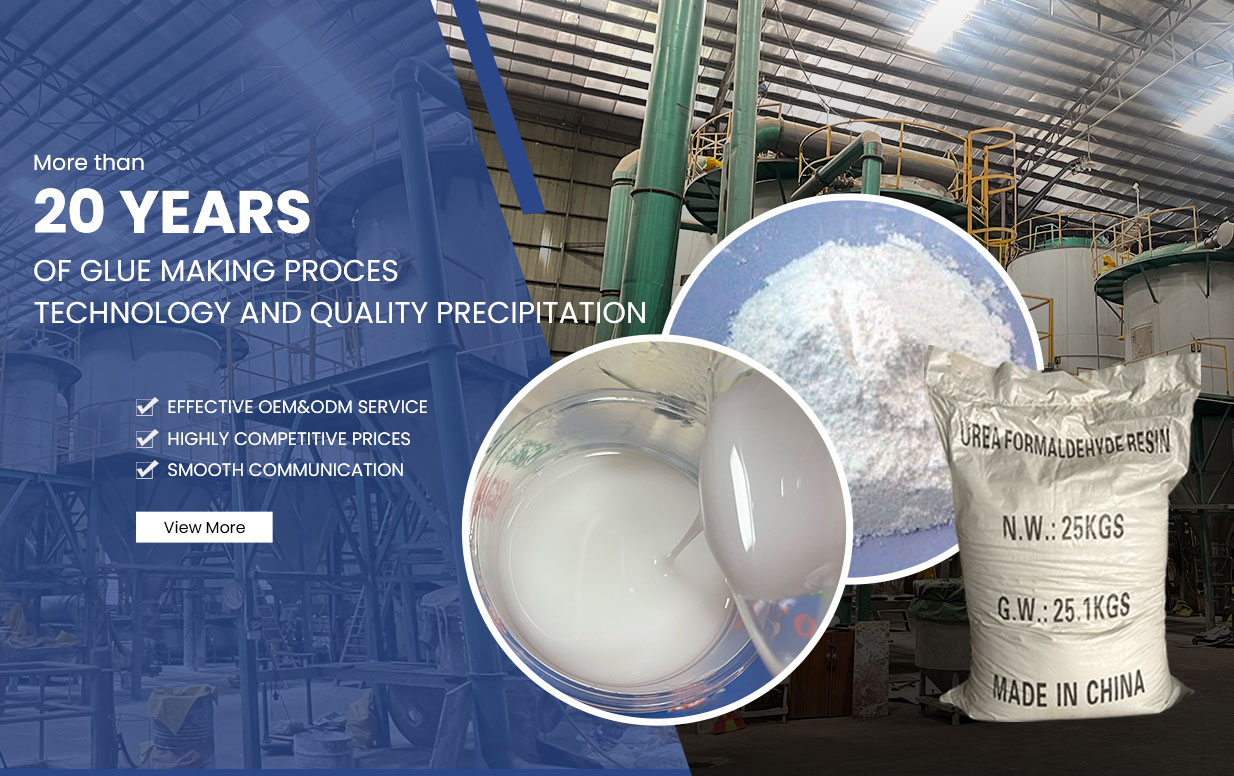
Formaldehyde resin powders are thermosetting resin systems supplied in a dry, free-flowing form that becomes an adhesive or binder after mixing with water and curing under heat and pressure. In wood-based panel production, this powder format is valued for stable storage, consistent batching, and fast response on hot presses, especially when output and bond repeatability matter in large-volume manufacturing. GOODLY focuses on urea-formaldehyde resin powder and related powder systems designed for wood panels, plywood gluing, and decorative-paper impregnation, helping factories standardize glue preparation and press performance across different product lines.
One of the most common applications is plywood manufacturing, where resin powder is mixed into an adhesive and spread between veneers before hot pressing. The cured resin forms a rigid crosslinked network that delivers high initial bond strength and supports efficient pressing cycles for repeated production runs. GOODLY’s urea-formaldehyde resin adhesive powder is positioned for plywood glue and general wood panel bonding where strong adhesion and fast curing are required.
For veneer overlay and lamination, the same resin chemistry is used to bond thin veneer sheets to core substrates such as plywood core or MDF, or to bond multi-layer assemblies where a thin, uniform glue line is essential for surface quality. Powdered UF systems are commonly selected when a plant wants predictable viscosity after mixing, steady spreadability, and a cure profile that matches the press schedule.
uf resin powders are widely used as binders for MDF and particleboard, where bonding must be strong enough to maintain panel integrity while supporting continuous, high-throughput production. GOODLY’s technical content highlights UF as a practical choice for interior wood products due to rapid curing response and cost efficiency, which is aligned with panel lines that prioritize stable daily output and consistent board properties.
For buyers specifying boards for regulated markets, emissions compliance becomes part of the application decision. In the United States, TSCA Title VI regulates formaldehyde emissions for hardwood plywood, MDF, and particleboard sold or imported into the market, shaping resin selection, process controls, and quality documentation.
Formaldehyde resin powders also play a key role in decorative surface materials, particularly impregnated paper used for laminated panels and furniture surfaces. Melamine-urea-formaldehyde resin powder is commonly used to impregnate decorative paper and improve surface durability and stability after pressing. GOODLY offers an impregnated-paper MUF resin powder positioned for wood processing and decorative paper impregnation workflows.
In practical terms, this application is about achieving controlled resin pickup in paper, stable curing on the press, and a finished surface that resists heat, chemicals, and daily wear in typical furniture and interior panel use.
Where higher moisture resistance is needed compared with standard interior UF use, modified powder systems are often chosen. GOODLY provides a waterproof glue powder under its MUF resin powder category and publishes a representative mixing procedure, indicating the product is intended for construction-oriented bonding where moisture performance is a priority.
Even in these use cases, the target is usually controlled exposure rather than long-term outdoor weathering. Matching the resin system to the service environment, press parameters, and finishing system is critical for reliable results.
Beyond flat panels, UF resin powders are used in molding compounds and in shaped wood assemblies such as bentwood parts. GOODLY offers a bend-wood uf resin powder product positioned for bonding during bending and clamping, where the adhesive must cure into a rigid structure that holds the formed geometry after release.
This application tends to emphasize predictable open time, rapid cure under heat, and low creep after curing so parts maintain dimensional stability.
| Application area | Typical goal in production | Common evaluation points |
|---|---|---|
| Plywood core bonding | Fast press cycles and strong veneer-to-veneer adhesion | Pot life after mixing, cure speed, dry bond strength, spread consistency |
| Veneer lamination | Thin, uniform glue lines and clean surface finish | Viscosity stability, penetration control, press temperature window |
| MDF and particleboard | Stable board properties on continuous lines | Cure response, resin distribution, emissions compliance needs |
| Decorative paper impregnation | Durable, stable decorative surfaces | Resin pickup control, cure completeness, surface durability |
| Moisture-oriented construction bonding | Better moisture tolerance than standard interior panels | Water resistance targets, press schedule fit, formulation consistency |
| Bentwood and shaped components | Rigid set and shape retention after forming | Open time, clamp time, rigidity after cure |
Formaldehyde resin powders are performance materials, but the finished outcome depends on process discipline. Key controls usually include water addition and mixing uniformity, glue standing time, spread rate, veneer or furnish moisture, press temperature and pressure, and post-press conditioning. Environmental and safety requirements matter as well: formaldehyde is classified as carcinogenic to humans by IARC, and workplace controls should follow applicable regulations and exposure guidance.
From a manufacturer perspective, GOODLY’s advantage is supplying dedicated resin powder products for different wood and surface workflows, along with product guidance that helps plants standardize glue preparation and scale to OEM/ODM and wholesale production requirements without sacrificing batch-to-batch consistency.