jianguli@goodlyglue.com
+86-18948072250

UF and MUF are both thermosetting amino resins widely used in wood-panel bonding and decorative surface production. The core difference is simple: MUF is UF upgraded with melamine chemistry, which changes how the cured network handles moisture, heat, and long-term durability. From a manufacturer’s viewpoint, choosing UF vs MUF is less about “better or worse,” and more about matching resin behavior to your press conditions, target panel performance, and emission compliance path.
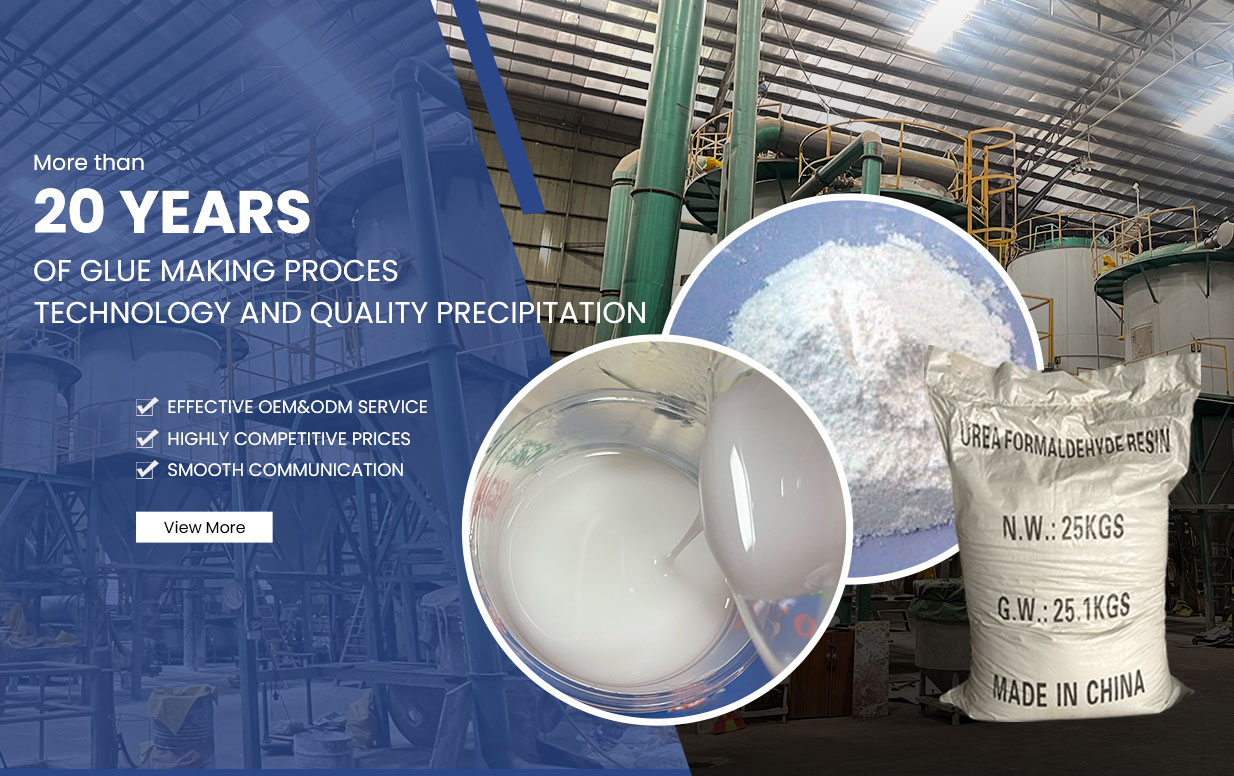
UF resin is urea-formaldehyde. In powder adhesive form, it is popular because it provides fast curing, strong initial bond strength, and efficient cost-performance for many interior-grade wood products. In production, UF is typically mixed with water and the required hardener system, then applied to veneers or fibers before hot pressing. GOODLY’s uf resin adhesive powder is positioned for plywood and wood-based panel manufacturing where consistent bonding, stable processing, and predictable cure are priorities.
Where UF shines is high-throughput pressing: it can reach target cure quickly, helping shorten press cycles. Where UF is naturally weaker is moisture durability: under sustained humidity, boiling-water tests, or wet-use conditions, the cured network can hydrolyze faster than modified systems.
MUF resin is melamine-urea-formaldehyde, a co-condensed resin network that integrates melamine units. That melamine portion typically increases water resistance, heat stability, and durability compared with plain UF, making MUF more suitable when panels must maintain bonding integrity under higher moisture exposure or more demanding service conditions. GOODLY’s Muf resin powder is described as a white powder used broadly in wood processing and decorative paper impregnation, where the resin must perform reliably through processing and in end-use environments.
A long-established technical finding in wood adhesives is that melamine-modified UF systems were developed specifically to improve durability and moisture resistance, and they can also support lower formaldehyde emissions compared with unmodified UF in certain formulations and board systems.
| Comparison point | UF resin | MUF resin |
|---|---|---|
| Resin chemistry | Urea-formaldehyde network | Co-condensed network with melamine + urea + formaldehyde |
| Moisture durability | Good for dry, interior conditions | Stronger moisture resistance for demanding humidity and durability needs |
| Typical fit | Plywood, particleboard, MDF, veneer bonding in interior applications | Panels, laminates, impregnated paper, flooring-related surfaces needing higher stability |
| Cure behavior | Fast cure is a common advantage in press operations | Often selected when performance outweighs resin cost, processing tuned to match system design |
| Emission strategy | Works with compliant formulation and process control | Melamine modification is commonly used to improve performance and can support emission optimization routes |
Many buyers must align panels with formaldehyde emission requirements for target markets. In the United States, TSCA Title VI regulates emission limits for composite wood products such as hardwood plywood, particleboard, and MDF. In Europe, the E1 class is commonly referenced, including a chamber limit of 0.124 mg/m³ under EN 717-1 test conditions.
It is important to separate two controls:
Resin selection: MUF can provide a more durable network, helping boards maintain performance when moisture drives stress on glue lines.
Process and formulation control: emission compliance is also driven by press parameters, scavenger strategies, and quality control routines, not only by choosing UF or MUF.
If you need a single takeaway for specification work, it is this: pick UF when dry-condition performance and throughput are the priority; pick MUF when moisture durability and stability are non-negotiable.
UF is often a strong choice when you want:
Stable bonding for interior plywood and standard wood panel production
Efficient curing for high-volume lines
A cost-effective adhesive system for large runs and bulk order planning
GOODLY’s UF resin adhesive powder portfolio focuses on panel bonding needs like plywood and particleboard production, emphasizing consistent performance and ease of use in industrial environments.
MUF is often the better fit when you need:
Enhanced resistance to humidity-driven bond degradation
Higher durability expectations in end products
Decorative paper impregnation or surface-related processes where stability matters
GOODLY positions its muf resin powder for wood processing and impregnated paper applications, which typically demand stronger stability from the cured resin network.
A resin is only as consistent as its manufacturing control. For project buyers who must qualify adhesive performance across seasons and wood variability, GOODLY’s advantage is delivering focused UF and muf resin powder solutions aligned to wood-panel and impregnation use cases, supported by predictable supply capability and specification-oriented communication. If you are comparing UF vs MUF for an OEM/ODM program, the most efficient path is to define your target board type, moisture class expectation, press profile, and compliance requirement first, then match the resin system and supporting additives accordingly.
UF resin: fast curing, strong initial bonds, ideal for many interior wood panels.
MUF resin: melamine-modified network designed for better moisture durability and stability.
Best practice: decide based on service environment, process conditions, and compliance requirements, then lock the resin grade and QC plan with your supplier.
If you want, I can also write a short “selection checklist” you can place on your independent site so visitors can self-identify UF vs MUF needs by panel type, press line, and target market standard.