
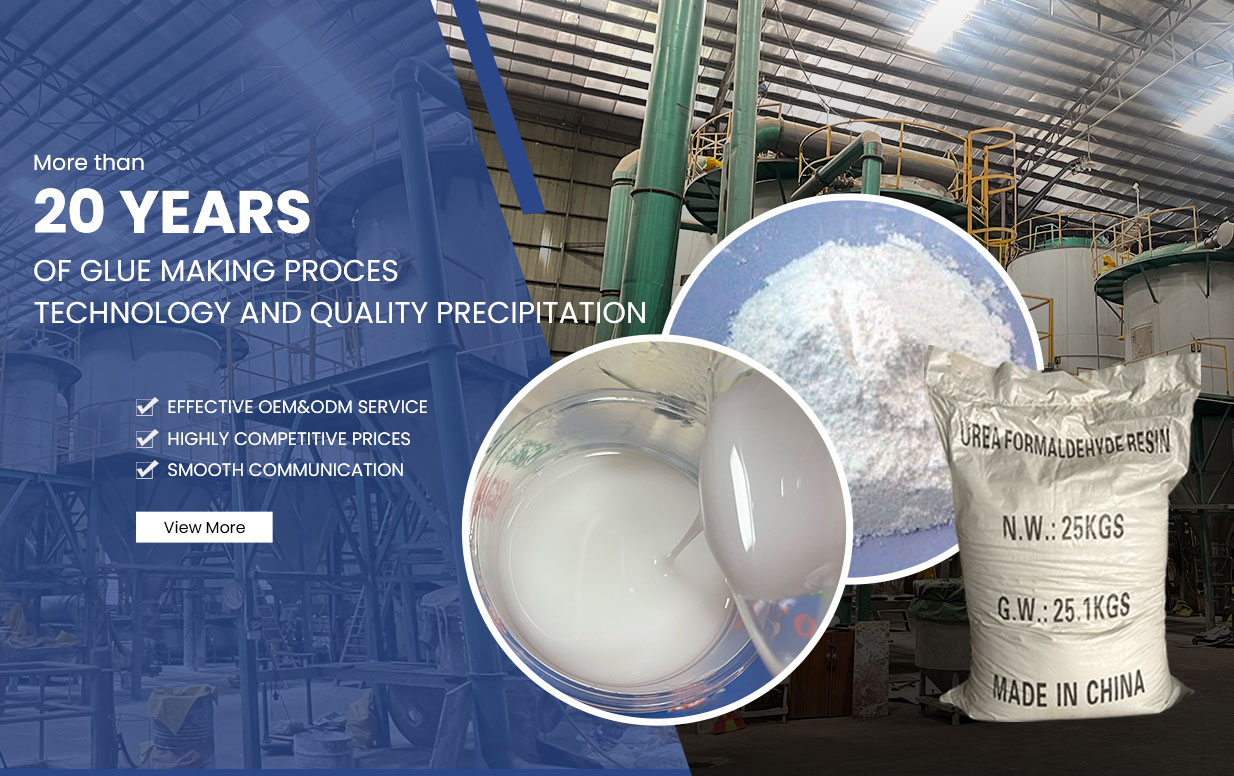
Urea-formaldehyde (UF) resin is a thermosetting polymer widely used in adhesives, coatings, and composite materials. Its morphology and crystallinity are primarily controlled by the urea-to-formaldehyde molar ratio during synthesis.
Urea-formaldehyde (UF) resin is widely used as an adhesive in the manufacturing of wood-based panels such as particleboard, MDF, and plywood. Its influence on the pyrolysis and thermal degradation behavior of these panels is a critical factor determining product stability, fire resistance, and environmental performance.
Urea-formaldehyde (UF) resin powder is one of the most widely used thermosetting polymers in wood adhesives, particleboard, and molded products. Its low cost, fast curing, and high initial bond strength make it a popular choice in manufacturing.
Urea-formaldehyde (UF) resins are among the most commonly used adhesives in the production of plywood, particleboard, and medium-density fiberboard due to their strong bonding strength and cost efficiency. However, formaldehyde emission from these resins remains a major environmental and health concern.
Formaldehyde is a common emission from urea-formaldehyde (UF) resins used in wood panels, furniture, insulation materials, and various interior construction products. As awareness of indoor air quality continues to rise, many buyers and manufacturers are examining how formaldehyde exposure affects long-term health.
Temperature plays a decisive role in the performance of urea formaldehyde glue, influencing its curing behavior, internal bond formation, and long-term durability. As a thermosetting adhesive widely used in wood panels, furniture production, and engineered building materials, its strength depends on controlled heat during curing and stable environmental conditions during service life.
Improving the bonding speed of UF resin powder is essential for manufacturers in wood-based panel production, furniture assembly, veneer lamination, and other applications requiring efficient adhesive performance. Faster curing directly impacts production throughput, energy consumption, and final product consistency.
Urea-formaldehyde resin is widely used in wood panels, furniture manufacturing, interior decorative boards, and various composite materials. Its fast curing, strong bonding strength, and cost efficiency make it a preferred adhesive for many production lines.
Urea-formaldehyde (UF) resin powders are widely used in manufacturing wood-based panels such as particle board or medium density fiberboard (MDF), as well as adhesives and molding compounds. Although the bulk material often appears as a stable, free-flowing powder or granules, its composition includes residual free formaldehyde — a volatile substance recognized as hazardous.
Understanding the differences among urea-formaldehyde, phenol-formaldehyde, and melamine-formaldehyde resins is important for manufacturers who need reliable thermosetting adhesives or structural binders. Each system offers distinct strengths in mechanical behavior, moisture performance, curing profile, and long-term stability, which directly influences its suitability in wood panels, laminates, insulation, industrial composites, and molding applications.