jianguli@goodlyglue.com
+86-18948072250

The performance of adhesives is a critical factor in the production of wood-based panels such as particleboard, medium density fiberboard (MDF), and plywood. Urea-formaldehyde (UF) resin remains one of the most widely used adhesive systems due to its cost-effectiveness, high initial bond strength, and compatibility with common pressing processes. Recent industrial practice has explored combining powder uf resin with liquid UF resin to achieve balanced performance, handling, and cost benefits. This article discusses how this blending affects adhesive performance in wood-based panels, with practical considerations for manufacturers.
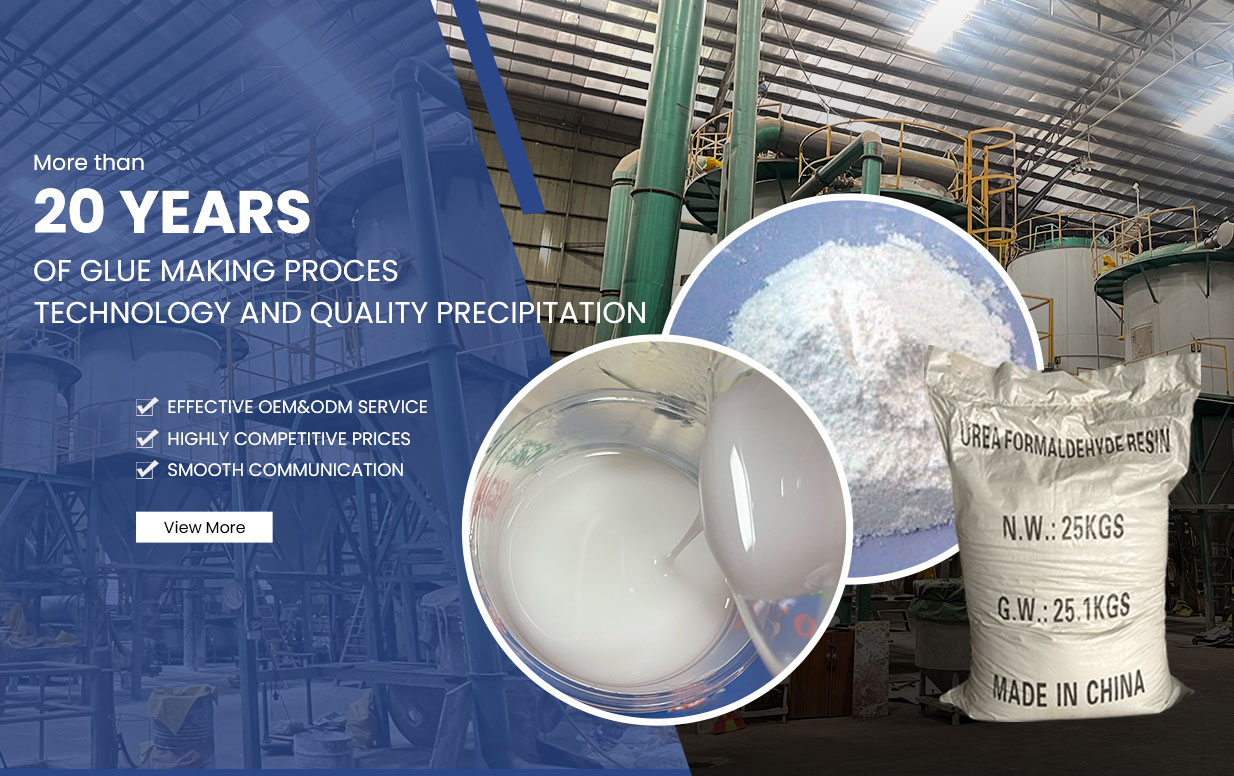
Powder UF Resin Powder UF resin is a dry adhesive form that offers storage stability and ease of handling. It typically contains pre-condensed components that require rehydration before use, or it may be applied directly in dry blending processes where the resin is mixed with wood furnish.
Liquid UF Resin Liquid UF resin is the conventional adhesive used in panel plants. It is mixed with water and additives to achieve the desired solids content and viscosity. Liquid resin provides uniform penetration into wood fibers and fast curing under heat and pressure.
Blending powder and liquid UF resins aims to combine the advantages of both, optimizing adhesive distribution and curing behavior.
When powder UF resin is added to liquid UF resin, overall viscosity increases depending on the proportion of powder. Higher viscosity can:
Improve the adhesive’s ability to remain on wood surfaces during blending and mat formation.
Reduce excessive penetration into fine wood particles, which can limit glue line effectiveness.
Require adjustments to application equipment to maintain uniform spread.
The curing process of UF adhesive is influenced by resin chemistry, temperature, and catalyst concentration. The inclusion of powder UF components can:
Modify the cure rate due to altered reactive group availability.
Require calibration of catalyst dosage to ensure complete polymerization.
Influence gel time and hot-press dwell time, which affects production throughput and final strength.
An optimized balance between powder and liquid components maintains efficient curing without unwanted delays.
Bond strength in wood-based panels is a key performance indicator, reflecting both initial adhesion and long-term durability. Mixing powder with liquid UF resin can:
Enhance bond line thickness and uniformity if distribution is controlled.
Affect internal bond (IB) and modulus of rupture (MOR) values through changes in adhesive distribution and penetration.
Potentially improve dry bond performance while requiring careful control under humid conditions.
Empirical testing is important in determining optimal blend ratios for specific panel types.
UF resins are associated with formaldehyde emissions, which are regulated in many markets. The consolidation of powder and liquid resins may impact emission behavior:
Powder UF often contains lower free formaldehyde due to pre-polymerization, which can reduce overall emissions when blended at suitable ratios.
Correct formulation and curing help minimize free formaldehyde in final panels.
Emission performance should be verified through industry standard testing protocols.
Manufacturers often monitor this aspect closely to comply with environmental standards.
| Property | Liquid UF Only | Powder + Liquid UF Blend |
|---|---|---|
| Viscosity | Lower, uniform flow | Adjustable, potentially higher |
| Handling | Requires careful storage | Easier dry handling with powder component |
| Penetration into wood particles | Higher penetration | Controlled penetration |
| Cure rate | Standard with catalyst control | May require catalyst adjustment |
| Bond line uniformity | Good with proper application | Potentially improved with optimal blend |
| Formaldehyde emission | Moderate | Lower with high powder ratio |
Proper blending of powder and liquid UF resins is essential for consistent performance. Key steps include:
Accurate proportioning based on target solids content and panel type.
Adequate distribution of powder particles in liquid to avoid agglomeration.
Controlled addition of curing agents and extenders to maintain reaction balance.
Manufacturing equipment must accommodate changes in adhesive properties:
Spray or blending equipment may need adjustments for higher viscosity blends.
Press cycle times should be evaluated to ensure complete cure without excessive energy use.
Before full production implementation, trial runs should include:
Internal bond strength tests to verify adhesive effectiveness.
Mechanical tests such as bending and screw withdrawal resistance.
Formaldehyde emission testing according to regulatory standards.
These evaluations help identify the most effective blend for specific panel grades.
Mixing powder UF resin with liquid UF resin offers an approach to improve adhesive performance for wood-based panels. A well-designed blend can enhance handling, control penetration, and potentially reduce formaldehyde emissions while maintaining or improving bond strength. Manufacturers should consider viscosity behavior, curing dynamics, and practical processing adjustments when adopting blended resin systems. Through careful formulation and testing, this strategy can contribute to high-quality panel production with consistent performance.