jianguli@goodlyglue.com
+86-18948072250

Furniture quality is never decided by wood species alone. Bonding performance has a direct impact on panel stability, veneer appearance, machining results, production efficiency, and long-term durability. In modern factories, the wrong adhesive can cause delamination, edge lifting, uneven pressing results, surface defects, and unnecessary rework. That is why selecting the right wood adhesive for furniture is a technical decision tied to both product performance and factory cost control. GOODLY focuses on Urea Formaldehyde Resin Powder and customized adhesive products, and its location in Foshan gives it close contact with one of China’s major furniture manufacturing clusters.
The first step is not comparing prices. It is identifying what the adhesive must bond and how the finished furniture will be used. Different furniture products place different demands on the bonding system. Particleboard furniture, density board components, plywood structures, decorative veneer panels, and bent wood parts do not behave the same way during pressing, cutting, drilling, and finishing. GOODLY offers resin powder solutions for plywood, particleboard, density board, decorative veneer, and bent wood applications, which reflects how adhesive selection should follow substrate and process requirements rather than one universal formula.
For example, a flat laminated cabinet panel usually needs stable spreadability and clean surface performance. A bent chair component needs stronger bonding security during forming to reduce cracking and delamination risk. A veneered decorative board needs good appearance control so the glue line does not interfere with the final finish. Matching the adhesive to the board structure helps reduce later problems that often appear only after hot pressing or machining.
Fast curing looks attractive, but adhesive speed must match the real line condition. If curing is too fast, glue may lose workable time during spreading or assembly. If curing is too slow, press efficiency drops and output becomes harder to maintain. A suitable adhesive should support a stable window between glue preparation, coating, assembly, pressing, and post-processing.
GOODLY describes its urea formaldehyde resin powder as an adhesive system that can balance curing rate and bonding strength through formulation and process adjustment. Its product guidance for decorative wood veneer also notes hot pressing temperatures of 80 to 120°C, pressure of 8 to 16 kg per square centimeter, and pressing time of 1 minute per millimeter of board thickness, which shows how adhesive choice should always be linked to actual process settings rather than generic claims.
A factory running continuous output should ask practical questions before confirming any furniture grade adhesive solution:
Can the glue stay workable during mixing and spreading
Does the press cycle fit current equipment capacity
Will curing consistency remain stable across different seasons
Can the bond hold up after cutting, edge banding, sanding, and assembly
Many buyers focus only on adhesion strength. That matters, but machining performance is equally important in furniture production. A strong bond that causes brittle edges, dirty cutting surfaces, or unstable drilling results can still raise the total manufacturing cost.
A good adhesive should help produce panels and components that remain stable during sawing, routing, drilling, edge treatment, and final assembly. GOODLY states that its powder systems are designed for strong adhesion, faster curing, and reliable processing in wood applications, while its bent wood and particleboard products are presented as solutions for preventing delamination and improving structural stability.
In furniture plants, this translates into fewer rejects, more predictable processing, and better consistency between production batches. These are the points that support margin protection more than a low unit price alone.
An adhesive that performs well in theory may still create issues in daily factory work if storage and preparation are difficult. Powder systems are often selected because they support easier storage and transport management, but factories still need to confirm moisture sensitivity, shelf life, and mixing consistency.
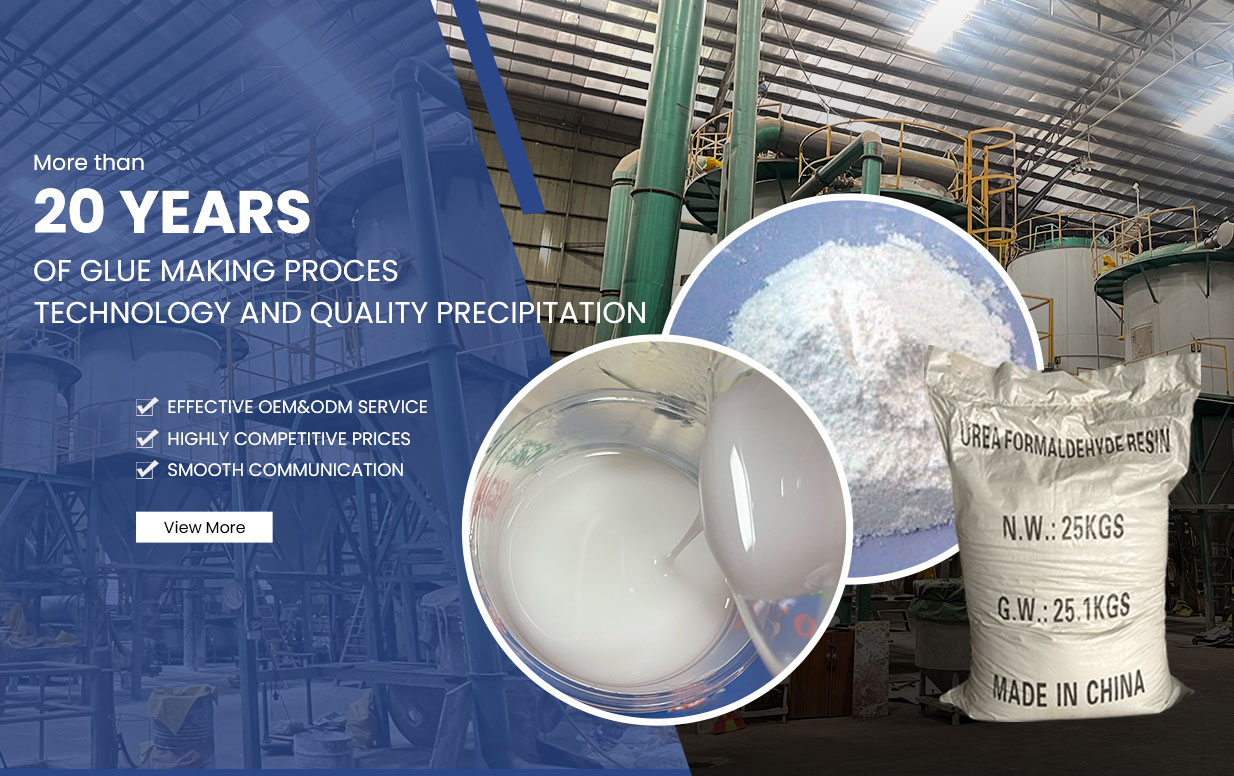
GOODLY states that one of its urea formaldehyde powder products is a white powder with a shelf life of one year. The company also emphasizes customized formulations and stable batch consistency, which is important for plants that need repeatable results across large-volume orders.
Before final selection, it is smart to review:
| Factor | Why it matters in furniture production |
|---|---|
| Shelf life | Helps reduce waste and supports inventory planning |
| Mixing stability | Affects glue line uniformity and operator control |
| Batch consistency | Supports steady press results and fewer quality variations |
| Storage condition | Influences powder flow, reactivity, and final performance |
| Application fit | Ensures the adhesive matches board type and press method |
This is especially important in the furniture manufacturing supply industry, where production delays often come from process mismatch rather than raw material shortage alone.
Not all furniture faces the same environment. Bedroom furniture, office furniture, dining furniture, and interior decorative panels all experience different humidity conditions. Adhesive selection should reflect realistic exposure, not the most extreme scenario and not the lowest cost option by default.
For standard interior furniture, a controlled urea formaldehyde system is widely used because it offers an efficient balance of cost, bonding, and production speed. Where better moisture resistance is needed, modified systems may be more suitable. GOODLY also presents melamine modified adhesive powder for improved waterproof performance in specific applications, which shows the value of selecting adhesive grade according to actual service conditions.
The key is to define the use environment early. A panel for dry indoor cabinetry does not need the same adhesive strategy as a component exposed to higher moisture variation.
Furniture producers rarely operate with one board, one line, and one press condition. Adhesive performance depends on raw material moisture, board density, ambient temperature, equipment pressure, pressing temperature, and target output speed. That is why supplier support matters.
GOODLY highlights customized urea formaldehyde resin adhesive products based on customer requirements, along with application coverage across multiple wood processing segments. For furniture factories, this means the adhesive can be discussed as part of the process, not treated as a standard commodity.
A supplier with application understanding can help answer the questions that affect production most:
Which resin powder grade fits the current board structure
How should pressing conditions be adjusted for better bonding
What changes help reduce delamination or unstable glue lines
Which formula is more suitable for veneer, panel core, or bent components
This is where an industrial glue powder supplier adds real value beyond quotation speed.
GOODLY is focused on urea formaldehyde resin powder and related adhesive solutions for wood processing, with product coverage that includes plywood, particleboard, density board, decorative veneer, and bent wood applications. The company also emphasizes customization, batch stability, and its base in Foshan, a major furniture materials region. For buyers comparing adhesive options, these factors matter because they connect product development with real manufacturing conditions.
A reliable adhesive decision should support pressing efficiency, surface quality, machining stability, and consistent output. In furniture production, the best adhesive is not simply the strongest or the cheapest. It is the one that matches the board, the process, the equipment, and the quality target with the least friction across daily manufacturing.
GOODLY can support that evaluation with application-focused resin powder options and customized adhesive development for wood-based furniture production.