jianguli@goodlyglue.com
+86-18948072250

formaldehyde control is no longer only a compliance topic. It is a performance topic that affects odor, curing stability, customer acceptance, and downstream certification. Regulators and health agencies consistently treat formaldehyde as a substance of concern, and the U.S. EPA IRIS program classifies it as carcinogenic to humans by inhalation.
From a manufacturer perspective, lowering emission is most reliable when formulation, pressing process, and verification testing are designed as one closed loop.
Before adjusting chemistry, define the target with a recognized test method and limit value. The most common references in wood-based panels and furniture supply chains include EN 717-1 chamber testing and U.S. TSCA Title VI labeling requirements.
A practical way to align internal QC with buyer expectations is to map your product to a target class and test method.
| Reference system | Typical limit value | Typical method signal |
|---|---|---|
| EN 717-1 emission class E1 | 0.1 ppm, equal to 0.124 mg per m3 | Chamber concentration at defined conditions |
| WHO indoor air guideline | 0.1 mg per m3 as a 30-minute guideline | Short-term irritation prevention benchmark |
| U.S. TSCA Title VI composite wood limits | HWPW 0.05 ppm, PB 0.09 ppm, MDF over 8 mm 0.11 ppm | Compliance labeling and third-party certification |
Most emission in urea-based systems originates from free formaldehyde and reversible bonds that can release under heat and humidity. The main levers are the resin synthesis window, the molar ratio strategy, and the choice of modifiers and scavengers.
Key levers that typically deliver measurable reduction:
Lower free formaldehyde by controlled ratio design
Adjusting the urea to formaldehyde ratio and reaction endpoint can reduce the free formaldehyde pool while maintaining workable viscosity and curing response. This approach is widely used in panel-grade systems and must be validated against gel time and bond strength.
Add formaldehyde scavengers with a curing plan
Peer-reviewed reviews and studies describe scavengers like urea and ammonium salts that react with or capture formaldehyde, lowering emission. The trade-off is often a slower setting rate or reduced mechanical performance if dosage is not balanced.
Use modifier chemistry to bind more reactive groups
Research on uf resin modification reports reduced free formaldehyde when specific modifiers are introduced at controlled stages, which can improve emission outcomes when processing windows are stable.
Even an optimized resin can fail emission targets if the press line and storage conditions are unstable. The biggest production-side causes are incomplete cure, over-acid catalysis, wet furnish, and thermal overexposure.
Manufacturing checkpoints that matter:
Cure completeness
Under-cure leaves reactive fragments that can off-gas later. Manage press temperature, time, and mat moisture to achieve consistent cure across core and surface.
Catalyst and hardener control
Over-aggressive catalysis can create brittle networks and increase hydrolysis sensitivity. Standardize addition point, mixing time, and batch-to-batch gel time windows.
Moisture management
Humidity and water uptake can accelerate chemical degradation pathways and increase release over time, so resin storage, powder blending, and furnish conditioning must be controlled.
Emission reduction becomes repeatable when every batch has traceable QC outputs tied to the buyer’s target method.
A simple, audit-friendly workflow:
Incoming raw material checks for key contributors to free formaldehyde risk
Batch records for synthesis endpoint, blending uniformity, and gel time control
In-process checks during mixing and application for solids consistency
Finished panel or finished goods chamber testing to the required reference
Labeling and documentation alignment for the destination market, including TSCA Title VI expectations in the U.S.
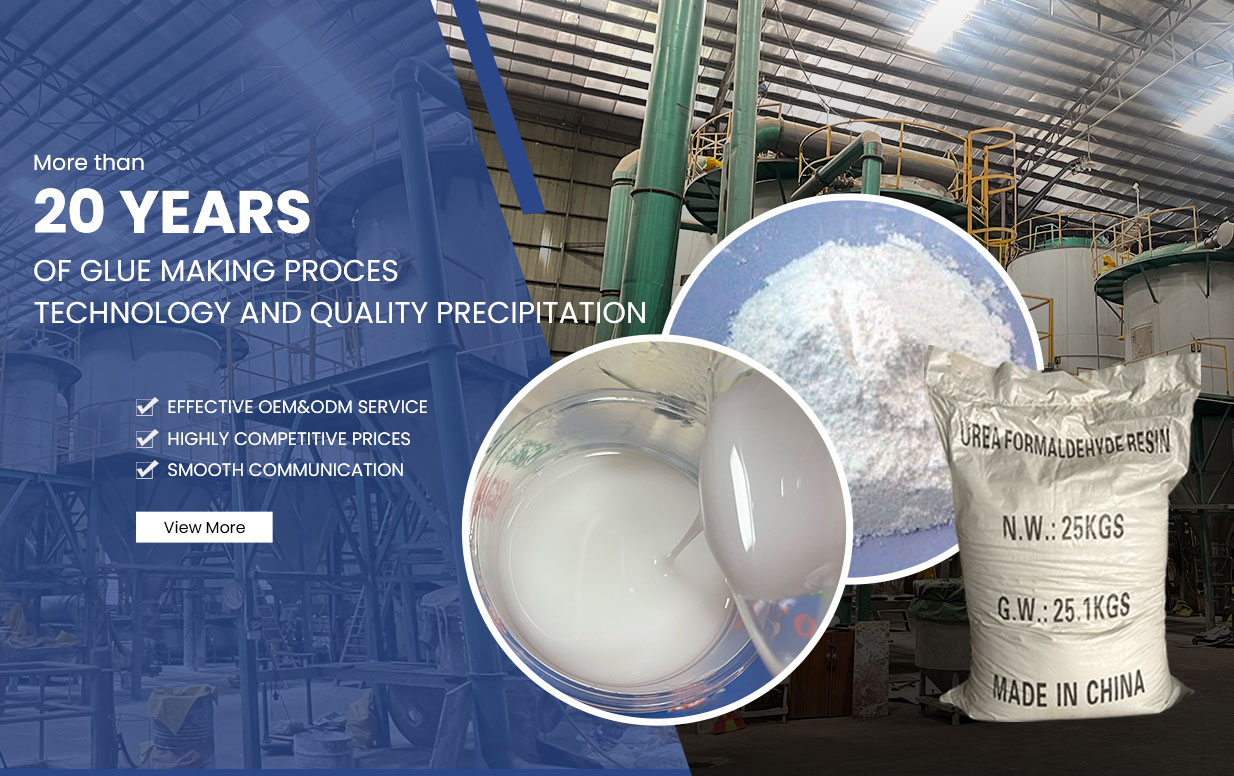
GOODLY focuses on urea-formaldehyde resin powder manufacturing with long-term experience and customization capability, aiming to match different pressing lines and end-use requirements through tailored formulations and stable supply.
In many factories, Urea Formaldehyde Powder is selected because it supports consistent blending and predictable curing across plywood, particleboard, and fiberboard production when matched to the correct catalyst system and press window. GOODLY offers multiple resin powder categories and application-focused grades to help maintain bonding strength while pursuing lower emission targets.
Lower formaldehyde emission is achieved fastest when you combine three actions: set a measurable target, reduce the free formaldehyde potential in the formulation, and lock process variables with QC checkpoints. With a structured verification plan aligned to EN 717-1 or TSCA Title VI expectations, emission improvements become predictable rather than trial-and-error.
For project discussions, prepare your target limit, test method requirement, board type, press parameters, and desired curing speed. GOODLY can then propose a resin powder direction and QC plan that fits your production reality.